


In a significant number of cases, patients encounter this diagnostic procedure when dealing with a dental problem, but as prevention becomes increasingly important for many, they often seek out examinations using modern, digital tools specifically.
Indeed, with the help of precise intraoral X-ray machines, 3D CBCT imaging devices, 3D scanners, and artificial intelligence, it is possible to detect potential problems not only faster but also more effectively.
Comprehensive precise dental diagnostics are also available at the NaturaDent practice in Budapest, which, with the help of the most modern equipment and imaging methods, provides an all-encompassing, thorough diagnosis for the treatment of an existing dental problem.
What is complex precise dental diagnostics?
The foundation of the success of all dental care is a correct diagnosis, as all treatment plans are based on this. Complex precise dental diagnostics offers enormous help in this, as it provides a comprehensive solution with which even unseen problems can be uncovered.
Tons of dental problems are caused by conditions deep beneath the gums. This complex method allows for the examination of the entire oral cavity, as well as, for example, the roots of the teeth, the jawbones, or a significant part of the facial bones.
Primarily based on imaging procedures, dentists are able to examine the underlying causes.
High-quality imaging methods with rich detail can yield diagnostic findings that provide a solid foundation for compiling a personalised, successful treatment plan.
When is complex, precise dental diagnostics needed?
If we want to answer this question very briefly, we can say that complex, precise dental diagnostics are most needed when the factors causing the problem are not visible, but their investigation is essential for treatment.
Naturally, the situation is far from this simple, so let's look at the topic a little more closely:
- Before a major dental procedure:For a slightly carious tooth, complex diagnostics are usually not necessary, but before implant placement, or in case of aesthetic correction or major oral surgery, it is essential.
- The causes of the complaint are not clear: If a patient's complaints, such as pain, swelling, or a loose tooth, are unclear, more detailed diagnostics can shed light on underlying problems.
- Preventative purpose:If someone suffers from periodontal disease or chronic gingivitis, or if other risk factors are present, complex dental diagnostics can be used to continuously monitor the patient's condition and prevent more serious changes.
- In cases of complex clinical picture:In cases of occlusal discrepancies or temporomandibular joint complaints, we can speak of a complex condition. Thorough diagnostics are essential for their successful treatment and to mitigate risk.
What does complex precise dental diagnostics in Budapest consist of?
Comprehensive, precise dental diagnostics are a particularly sought-after service in Budapest; however, the number of clinics capable of performing the examination process properly with modern equipment and sufficient professional expertise is limited.
A complex diagnosis should comprise the following elements:
Anamnesis
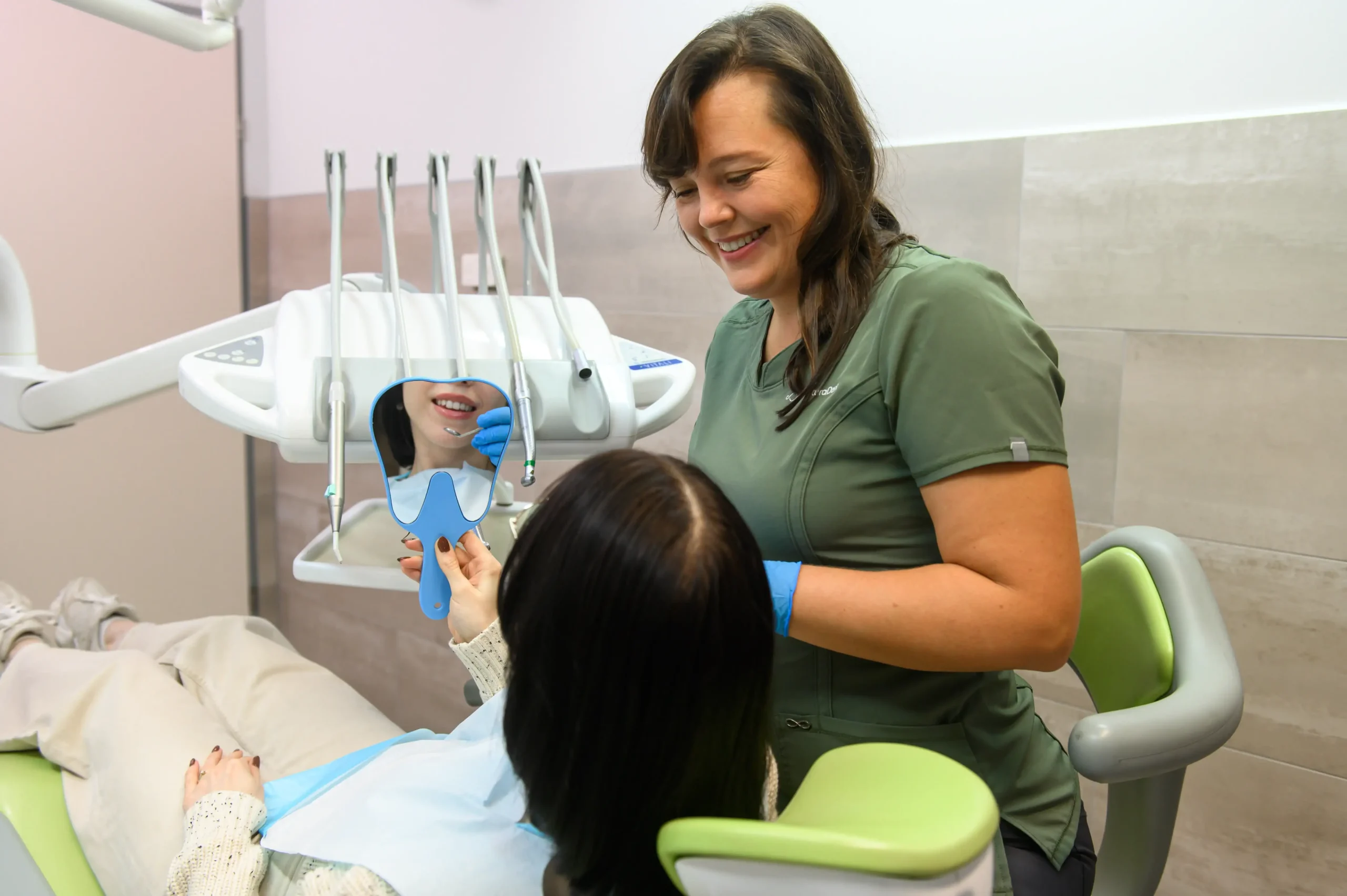
In our case, anamnesis means that in addition to a thorough oral examination, the dentist listens to the patient's symptoms, and asks important questions depending on the lesion and the potential treatment options.
For example, it is essential to cover chronic illnesses, regularly taken medications, oral hygiene habits, and previous dental procedures when revealing the medical history.
Imaging investigations
The most important part of comprehensive diagnostics is imaging tests. In this regard, dentists have a variety of methods to choose from depending on the symptoms. The most common imaging diagnostic options are as follows:
-
Intraoral (periapical) X-ray:
Then it can be a good choice if only one tooth, or a few adjacent teeth, need to be exposed. It can be advantageously used for diagnosing the background of problems related to the tooth root or the root apex.
-
Panoramic X-ray
A panoramic X-ray helps to provide a comprehensive image of the entire dentition and the jawbones, making it one of the best alternatives when a general assessment is needed, or when the dental problem affects a larger area or multiple teeth.
-
3D CBCT
The most modern and precise imaging method that can capture a three-dimensional image of tooth roots, as well as the bones of the face and jaw. It is particularly effective before implants, surgeries, or other interventions affecting the jawbone.
Preparation of a treatment plan
After performing imaging examinations, dentists are able to make a diagnosis and, consequently, develop a treatment plan that can permanently and safely alleviate the patient's complaints.
The treatment plan must, of course, always be discussed with the patient, with particular attention to the expected costs, benefits, and potential risks.
The aim is for the patient to be able to see and understand, based on the diagnostic results, how their problem can be addressed with the planned intervention.
What are the advantages of complex precision dental diagnostics?
Comprehensive diagnostics possesses many beneficial properties in the process of uncovering dental problems. Let's look at the most important ones:
- A more accurate diagnosis:Most importantly, thanks to modern imaging techniques, much more accurate diagnoses can be made; for example, 3D CBCT may even be suitable for mapping the anatomy of the jawbone.
- A more detailed treatment plan:As diagnostic tests allow us to see the source of the problem or the affected area in its entirety, a more precise treatment plan can be drawn up for the patient.
- Less risk:If the underlying cause of the problem can be identified through diagnostic tests, risk factors that might otherwise have led to complications later on can be ruled out from the treatment.
- More successful treatment:As the root causes and triggers of the problem can be identified more easily, the procedure can be carried out with a significantly higher success rate, which in turn promises better results in the long term.
Complex, precise dental diagnostics in Budapest, at the NaturaDent clinic
Comprehensive and precise dental diagnostics are, of course, also available at NaturaDent dental practice in Budapest. Why choose us?
- Outstanding professional experience:Our practice is staffed exclusively by highly experienced dentists and specialists, so you can be sure that we will find the right solution even for the most complex problems.
- Modern tools:We have Hungary’s largest and most advanced range of dental laser and diagnostic equipment, enabling us to provide world-class technology in every area, alongside our outstanding professional expertise.
- Personalised treatment plan:At our clinic in Budapest, following a comprehensive diagnostic assessment, we always provide our patients with a personalised, carefully drawn-up treatment plan, which sets out not only the cost estimate but also the treatment method.
- Premium care at an affordable price:NaturaDent is committed to providing premium care, so we guarantee the highest quality even at the diagnostic stage, whilst taking great care to ensure our services remain affordable.
The price of complex, precise dental diagnostics
As a range of methods and tools can be used as part of complex, precise dental diagnostics, we cannot speak of exact costs in terms of price.
For example, if a patient only needs a panoramic X-ray, we can provide this at the NaturaDent clinic for 15,000 Ft, whilst a 3D CBCT scan costs 25,000 Ft.
Our aim is for our patients to only pay for the services they truly need as part of their diagnosis, so the final total will vary in every case.
Do you have a problem with complex precise dental diagnostics in Budapest!
The complex, precise dental diagnostics at NaturaDent in Budapest is a service based on true professional foundations and the most modern equipment, which helps to uncover problems that are not visible to the naked eye.
If you have dental complaints or are facing a procedure that requires the investigation of internal processes, then you can contact us with confidence, because as part of our complex diagnostics, we can provide comprehensive and detailed results.
Frequently asked questions
What makes complex dental diagnostics precise?
This is because the most modern, high-resolution imaging devices are used for diagnosis, which can show the finest abnormalities, even hidden inflammation.
Is complex dental diagnostics painful?
As diagnostic imaging techniques are primarily used for diagnosis, diagnostics do not typically cause pain.
What radiation dose do the examinations involve?
Modern X-ray machines already operate with extremely low doses of radiation, making them completely safe to use under appropriate conditions. For example, the radiation from a panoramic X-ray is roughly equivalent to one to two days of natural background radiation.
Can complex dental diagnostics be used on pregnant women?
Not recommended, only in strictly justified cases, with outstanding radiation protection measures.
How long does a complex diagnosis take?
Patient and case-dependent. The entire process generally takes 30-45 minutes, including taking the medical history, imaging, and treatment plan.
Are all tests necessary for the diagnosis?
No, within complex precise dental diagnostics, only the imaging examination that can best reveal the area associated with the given problem is necessary.
Is any preparation required for the diagnostic?
It is recommended to remove metallic jewellery, necklaces, earrings, hair clips and piercings due to X-rays.