The best and most modern currently available
Treatments, with world-leading dental technologies

Implant, Periodontology

Our services Dentistry under anaesthesia

Dentistry under anaesthesia

Who, when and why is anaesthesia dentistry good for?

Many patients are afraid of dentists. Yet most are completely relaxed as soon as they enter our cosy downtown office and meet our friendly, knowledgeable staff. For them, our innovative and painless laser dentistry treatments are the perfect solution. Of course, we also think of our patients who have a fear of dental treatments due to childhood fears, panic disorder, nausea caused by increased garatreflex or other reasons.For them, we offer a reliable, predictable and 100% memory-free solution anaesthetic dentistry, which may be used for major oral surgery. These include dental implants, sinus elevation, and removal of cysts or large areas of inflammation.

Anaesthetic dentistry can also be an option for tooth extraction: when 4 wisdom teeth are removed at the same time, anaesthesia (as opposed to local anaesthesia) may be recommended even for people who are not afraid of dental treatments. In fact, our experienced dentists can do much more work during anaesthesia than with traditional anaesthesia.


This is how to attend a sedation treatment!

Although we will carry out a comprehensive assessment at your first appointment and prepare you thoroughly for everything you need to know for a successful anaesthetic treatment, you will find the most important information here too:

  • You should not drink for 3 hours before the procedure and eat 6 hours before the treatment. (This is necessary because the swallowing or coughing reflex does not work during anaesthesia, so there is a risk that the contents of the stomach may be thrown down the throat.)
  • You should tell your anaesthetist beforehand if you are taking any medicines regularly. (You will be advised on how to take them according to the instructions of your anaesthetist.)
  • Because you may need support after the intervention - due to the feeling of drowsiness, Ask a close relative or friend to accompany you to the treatment.! (Important: driving a car is forbidden for 24 hours following the procedure.)

You sleep, we work - The anaesthetic dental treatment process

  • The dental anaesthetist (anaesthesiologist) will review the findings of the preliminary examination.
  • After a physical examination, and after your questions have been answered, anaesthetic dentistry treatment begins.
  • Anaesthesia is administered by a consultant anaesthetist and an anaesthetic assistant. Once you are comfortably positioned, our specialists will monitor your condition throughout the procedure using ECG electrodes placed on your chest and a pulse oximeter clip on your fingertip.
  • After a tiny intravenous puncture, an anaesthetic infusion is hooked up and the anaesthetist places a mask containing pure oxygen in your mouth.
    You fall into a deep sleep. You will not feel any discomfort during the anaesthesia, thanks to the painkillers given intravenously.
  • Our experienced dentist will perform the complete procedure you need. Based on the monitoring, you will spend as much time in our comfortable care until full awakening, until all the parameters of the remission protocol are met.
    You regain your consciousness and the natural beauty and health of your teeth.

Preventative examinations are necessary for dental treatments under anaesthetic! During the consultation, you will receive a full answer to all your questions from our trained specialists, from the reasons for exclusion to what needs to be done and possible side effects.


We welcome you to our comfortable practice in the city centre.

Bone graft

Bone grafting for dental implants

Bone grafting may be necessary if there is insufficient bone at the site of the missing tooth to allow the planned implant to be placed in the correct position. By increasing the volume of bone, the procedure can create more favourable conditions for implant-supported tooth replacement.

During the implant consultation, we assess the need for bone grafting alongside the planned dental restoration. Based on this assessment, we can determine which procedure is appropriate and whether the bone grafting can be carried out at the same time as the implant placement or as a separate procedure.

I would like to book a consultation regarding dental implants

When might bone grafting be necessary?

Following the loss of a tooth, the surrounding bone undergoes remodelling, and its volume may decrease in the area where the tooth is missing. Periodontal disease, previous inflammation or injury can also affect the condition of the bone. For this reason, the size of the gap left by the missing tooth alone does not determine whether an implant can be placed.

When making this decision, we assess the planned dental restoration, the location of the implant and the surrounding anatomical structures. A different solution may be appropriate for a small local defect than for a more extensive bone defect.

Assessment and personalised planning

In addition to the oral examination, any available imaging scans must also be assessed. At Naturadent, the planning of bone grafting is aided by three-dimensional CBCT scans, which help to assess bone dimensions, the position of nerves and the relationship between the upper jaw and the maxillary sinus.

At the consultation, please tell us what medical conditions you have, what medicines you are taking, and whether you smoke. It is particularly important to mention, for example, diabetes, medicines that affect blood clotting, and treatments for osteoporosis. Do not stop taking any medicines on your own; any changes to your treatment will be discussed by your doctors.

Preparing for bone grafting

Please bring your previous dental X-rays and a list of the medicines you are taking to the consultation. If you use a removable denture, please mention this as well, as the pressure it exerts on the healing area needs to be taken into account. Please let us know if you have experienced unusual bleeding, prolonged healing or a drug allergy during any previous oral surgery.

Before the operation, please discuss the instructions regarding meals, medication and your journey home. These will also depend on the type of anaesthesia used; the preparations may differ depending on whether you are having a local anaesthetic, sedation or general anaesthesia. It is advisable to arrange your post-operative rest period and the date of your first follow-up appointment in advance to fit in with your work schedule.

Bone substitute materials and membranes

The procedure may be carried out using the patient’s own bone, processed human donor bone, animal-derived bone substitute or synthetic material. These options can also be combined. The bone substitute provides the space and framework necessary for new bone formation; it is not simply a filling material that sets immediately.

The choice of material is influenced by the shape and size of the defect, the surgical plan and your own preferences. The bone graft is often protected by a membrane, which helps to isolate the regenerating area from the soft tissues. Ask about the origin of the material and the membrane, particularly if you have any religious or personal reservations in this regard.

At Naturadent, sterilised, protein-free bone substitutes and collagen membranes of bovine origin are used. The specific material and the required quantity are determined by the individual treatment plan.

Minor and major bone grafting

For smaller defects, a granular bone substitute and a membrane can be applied to the affected area. For larger defects, a more complex reconstruction, such as a fixed bone block or another space-maintaining solution, may be required. Harvesting autologous bone may also require a separate surgical site.

In the area of the upper molars, a sinus lift may also be necessary due to the proximity of the maxillary sinus. This is a specialised procedure for increasing bone volume.

Bone grafting and implantation in one or two stages

Minor bone augmentation can be carried out at the same time as implant placement, provided the conditions are right. This requires sufficient existing bone and adequate initial implant stability.

In the case of a larger defect, the bone graft is prepared first, and implantation takes place once healing has occurred. The waiting period is typically measured in months and depends on the procedure, the material used and the healing process. The fact that the wound has closed on the surface does not yet mean that the bone can bear weight.

The bone grafting procedure and anaesthesia

The procedure can also be carried out under local anaesthetic; the appropriate method of anaesthesia will be chosen based on the extent of the operation and your condition. The dentist will expose the area to be treated, position the bone graft and secure it as necessary, and then close the wound.

The aim of anaesthesia is to eliminate surgical pain, but you may experience a sensation of pressure. Afterwards, you may experience pain, swelling and bruising. You will receive personalised advice from your doctor regarding pain relief and any medication you may need.

Protection of the area undergoing restoration

During the initial period, you must avoid injuring or putting strain on the surgical site. It is important to follow the instructions given regarding eating, brushing your teeth, rinsing (if necessary) and wearing removable dentures. Do not press on the wound, and do not attempt to remove the stitches or any visible material at home.

Smoking impairs wound healing and increases the risk of treatment failure. During the follow-up appointment, the condition of the wound is assessed, and subsequently the healing of the bone and the possibility of the next stage of treatment are evaluated. Proper cleaning and monitoring are also required later on to ensure the long-term maintenance of the implant and the dental prosthesis.

The expected healing time for the implant is 2–4 months without bone grafting; if bone grafting is carried out at the same time, this may take a further 1–2 months. This does not represent the total treatment time for bone grafting carried out as a separate operation, nor is it a guaranteed timeframe. The treating dentist will decide on the next step based on the follow-up examination. We also supplement bone grafting with a graft prepared from the patient’s own blood and laser biostimulation; the use of these is detailed in the treatment plan.

The successive stages of healing and tooth replacement

The first stage following surgery is wound healing. At this stage, it is important to monitor swelling, pain and the ability to keep the area clean, as well as to protect the surgical site. The dentist checks that the wound is healing properly and inspects the stitches. A reduction in symptoms may be a positive sign, but it does not in itself indicate how much new bone has formed.

In the next stage, the healing of the bone graft and the conditions for implantation are assessed. If the implant is scheduled for a separate appointment, the timing of the procedure is determined based on these results. In the case of simultaneous bone grafting and implantation, the healing of the implant must also be monitored.

The fabrication of the final crown, bridge or other implant-supported restoration is a further stage of treatment.

The first follow-up appointment takes place approximately one week after the operation. Stitches are removed in accordance with individual instructions, typically after 10–14 days. The patient receives an information and consent form, which also sets out the post-operative care instructions.

Possible complications and warning signs

Infection, wound dehiscence, displacement of the bone substitute or membrane, or inadequate bone formation may occur. In such cases, further surgery may be required. Depending on the surgical site and the bone graft, sensory disturbances may also develop.

If you experience increasing pain, a fever, discharge, a wound reopening or persistent bleeding, contact your doctor as soon as possible. Heavy, unrelenting bleeding, or difficulty breathing or swallowing, requires urgent medical attention.

Treatment and temporary dental restorations whilst healing

When you can return to work and sport depends on the extent of the operation, your symptoms and the nature of your work. Sedentary work and heavy physical exertion may require different assessments. When making plans, please let us know if you have an important event, a trip or a physically demanding task coming up; do not assume that you will definitely be able to cope with a full workload the very next day.

A temporary dental prosthesis may be an option in certain cases, but not all prostheses can be worn without modification following surgery. The prosthesis must not exert any harmful pressure on the treated area. You should only use your existing removable dental prosthesis in accordance with the advice given during your check-up and the instructions provided.

The cost of bone grafting and the alternatives

The cost of bone grafting depends on the size of the affected area, the procedure, the materials used and the surgical steps required. The quote will specify the fees for the bone graft, the implant and the final dental restoration separately.

If you do not wish to have a dental implant, or if this is not recommended, other types of dental restoration – such as a bridge or a removable denture – may be considered, depending on the results of the examination.

Frequently asked questions about dental bone grafting

Is bone grafting necessary for every implant?

No. It is only considered when there is insufficient bone volume or the bone shape is not suitable for the planned implant placement. The need for it must be assessed on the basis of the dental restoration plan and the examination.

Why isn’t it enough just to look at the site of the missing tooth?

The shape of the gum does not accurately reflect the dimensions of the underlying bone. For implant placement, the width and height of the bone, as well as its relationship to the anatomical structures, must also be assessed.

Is the bone graft always placed in the maxillary sinus?

No. Bone grafting may be required in various areas of the jawbone. A sinus lift is a specialised procedure carried out in the area around the upper back teeth, which has its own specific requirements and post-operative care guidelines.

Is autologous bone always used for bone grafting?

No. A variety of materials and combinations can be used. If an autologous bone graft is planned, the site of the bone harvest, as well as any associated symptoms and risks, will be discussed during the consultation.

Can the implant be inserted at the same time as the bone graft?

In certain cases, yes, provided that adequate initial implant stability can be ensured in the existing bone. In the case of larger defects, it is necessary to wait for the bone graft to heal first. The implantologist will decide on the timing.

How can you tell if the bone has healed?

The possibility of proceeding to the next stage can be assessed by means of a follow-up examination and, if necessary, a three-dimensional CBCT scan. The removal of stitches or the cessation of pain does not in itself prove that the area is ready to bear weight.

Will I be without teeth whilst I’m recovering?

At Naturadent, we also plan temporary tooth replacements, and we discuss the options for this before the operation. The solution depends on the location of the missing tooth and the surgical plan; protecting the healing area is our top priority.

When will I be able to go back to work or play sport again?

There is no set timeframe that applies to every operation. The implantologist will determine when you can return to normal activities based on the procedure and the strain it places on you. Do not resume sporting activities on your own, even if the wound is barely painful.

Can the success of bone grafting be guaranteed?

No. There is a risk of insufficient bone formation, infection or partial loss of the implant. The risk depends on your condition and the nature of the operation; a decision on the next steps can be made following an examination.

What should I do if I see foreign matter in the wound or if the wound reopens?

Do not attempt to remove or push back the material. Contact your doctor and ask for a check-up. It is particularly important to be examined as soon as possible if you have a fever, increasing pain or persistent bleeding.

Book an appointment

Book an appointment for an implant consultation. Based on the examination, we will discuss whether bone grafting is required and what treatment steps you can expect in your case.

I would like to book a consultation regarding dental implants

Implantology: „Digital” tooth implantation, dental implant, dental implantation with 3D digital planning and surgical guide

The dental implant one of the best and most modern methods for cases where we wish to remedy tooth loss not only aesthetically but also functionally.

Modern implant procedures offer all of this with sufficient safety and durability, so when implanted to the right quality, they not only look like natural teeth, but you can also chew and bite with them in the same way – practically without compromise.

However, quality should be emphasised, as only a few dental practices in Hungary still offer professional implantological procedures.

NaturaDent naturally belongs here, as our team's vast expertise, highly qualified implantologists, outstanding quality implants, and patient-centric approach ensure that tooth replacement truly lasts a lifetime.

Titanium, ceramic, or a combination of both.

As our dental practice places great importance on ensuring each patient receives the implant best suited to them, we strive for the highest quality right from the selection of raw materials.

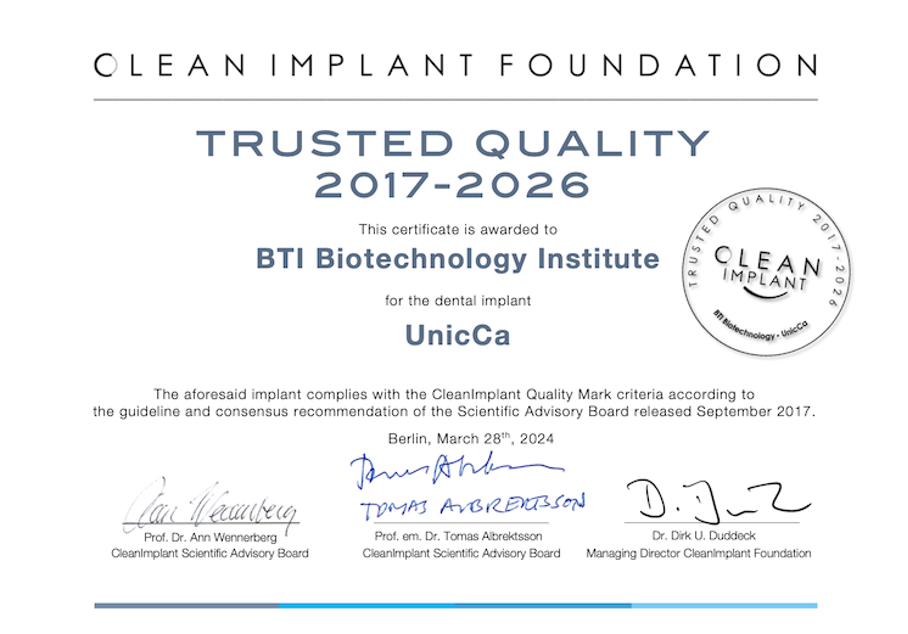
We exclusively work with premium quality solutions, which is why we use the world's first acquired Clean implant foundation. BTI implants, so the implants we insert are made of pure titanium and are provided with appropriate surface treatment in order to connect perfectly with the bone structure.

Naturadent BTI certification


This is essential to achieve a strong, practical, and aesthetically flawless result.

Regarding prosthetics and crowns, the range is already wider. In the former case, zirconium and titanium, and in the latter case, metal-ceramic, pressed ceramic, and zirconium-ceramic crowns can be placed on the implanted implant.

In making these choices, we always provide patients with comprehensive information about the benefits and drawbacks, and we make the final decision together.

The procedure for dental implant placement

Health check

As implants fitted by NaturaDent can serve patients for 50-60 years, we pay great attention to adequate preparations. The first step of this will be a state assessment, which is accompanied by a consultation and the taking of diagnostic images.

It is important to explore the intended environment of the implant and the patient's anatomical features, as it may be that the jawbone is thin – this is common in cases of long-term tooth loss – so bone grafting must precede implantation.

Design

If the condition assessment results indicate that the implant can be placed, the next step in the process is planning.

NaturaDent works in this area with three-dimensional spatial computerised x-rays (3D CBCT), which provide a precise background for elaborating even the most fundamental details.

If the jawbone is sufficiently strong and bone grafting is not required, a 3D scan of the patient's teeth is taken, which allows for the precise placement of the dental implant in the bone.

For this, our dental practice uses the most modern Smart Guide technology. With its help, implants can be placed with 100 percent accuracy, and the margin for error can be reduced to a minimum.

Implantation

Precise planning is followed by implant placement. At the NaturaDent clinic, this is considered a routine, painless minor surgery performed under local anaesthetic.

The first step will be to open the gum. This will be followed by the placement of the Smart Template, which helps to create the precise location of the screw in the jawbone, the so-called bone bed, into which the implant, temporarily sealed with a closure screw until the end of the healing period, can be precisely inserted.

The final step of the implantation is to stitch the open gum tissue together for rapid and aesthetic healing.

Placement of superstructure

After the designated healing period has passed, a check-up examination is necessary to verify if the implant has fused correctly with the bone, meaning it can withstand further loading. If so, before the fabrication of the tooth crown, the abutment follows, which ensures the connection between the implant and the future crown.

This is an important element as it can reduce the chances of inflammation around the implant, making not only placement easier but also increasing the durability of the final result. After the abutment is placed, some healing time is again required, along with a small healing cap, which will give the gum around the dental crown a beautifully pleasing shape.

Crown design

If the implant has healed and properly osseointegrated, meaning it can function as a fully integrated artificial root, then the crown can be created, which in the case of multiple implants can be a bridge or even a removable denture.

The type of crown that will be placed on the implant is always decided by the patient, but of course, we also help with this, because the cheapest solution is not always the right one, nor is the most expensive.

To create the crown, a 3D scanner provides the digital impression, allowing for a final result that perfectly matches the other teeth in every respect. The final step of the dental restoration is the proper fixation of the completed crown. In our practice, we use the screw-retained solution instead of cemented crowns, which is a much better option.

Implant aftercare

Despite precise preparation and planning, it's possible that an implant dental restoration may sometimes require post-insertion adjustment. Minor fine-tuning is, of course, possible, as the aim is for the patient to feel that the restoration is a fully functional tooth.

Although our experienced colleagues will inform patients about all aspects of implant aftercare, it should be noted that it is recommended to have the implant checked at least every 6 months, even if there are no complaints.

This is important not only because of the condition of the dental prostheses but also concerning fundamental aspects such as maintaining adequate oral hygiene, as periodontal disease can dislodge an implant just as it can natural teeth.

The patient's most important task during aftercare is therefore to clean the crown attached to the implant and its surroundings just as they would clean a natural tooth.

Why NaturaDent?

In our practice, every patient can receive Western-standard care, which is underpinned not only by our approach but also by our knowledge, the tools we use, and our high-quality implants.

We exclusively work with premium quality implants such as BTI (a strictly controlled, purest implant) or MDI Mini Implant, while from the very beginning of the planning stage, we utilise several solutions that are still only used by a few in this country, such as the Smart Guide digitally designed, pinpoint accurate template technology.

The strength of NaturaDent also lies in the institution's chief implantologist Dr Márta Fülöp Papp MSc MSc MSc., who studied in Germany and currently continues to publish and conduct several research projects on the topic.

Another of the clinic’s leading specialists is Dr Amirhossein Golkhorshidi, MSc, who, having completed a postgraduate specialisation in implantology, welcomes patients with a wealth of experience and expertise. At NaturaDent, a whole team of experts is at your disposal; please do not hesitate to contact us with any enquiries.

Laser periodontology

Periodontology deals with diseases of the tissues that support the teeth. If you experience bleeding gums, persistent bad breath, receding gums or loose teeth, periodontal disease may be the underlying cause of these symptoms. The aim of early treatment is to reduce inflammation, halt further damage and preserve your natural teeth wherever possible.

At Naturadent, we plan your periodontal treatment based on a detailed examination. We tailor professional cleaning, subgingival treatment, surgical options where necessary, and maintenance care to your individual condition. Laser procedures are also available at our clinic; we decide on their use as part of your comprehensive treatment plan.

I’d like to book a periodontology consultation

When should you see a periodontist?

A check-up is advisable if your gums bleed regularly when you brush your teeth or floss, or if they are swollen, red or sensitive. Persistent bad breath, discharge near the gums, widening gaps between the teeth and changes in chewing habits can also be warning signs. Loose or shifting teeth should be examined as soon as possible.

Periodontal disease may cause little pain for a long time, or may even be painless. The absence of pain is therefore not a reliable indicator of the condition of the gums and bone. In smokers, bleeding may also be less noticeable, whilst the disease continues to progress.

Swelling that develops rapidly, severe pain or a pus-filled lesion requires an urgent dental examination. In such cases, please describe your symptoms when booking an appointment so that we can refer you for the appropriate treatment.

Gingivitis and periodontal disease

In the case of gingivitis, it is primarily the gums surrounding the teeth that become inflamed. If the plaque and tartar causing the condition are removed and oral hygiene at home is improved, this condition can usually be reversed. However, untreated inflammation should be taken seriously.

In the case of gum disease, or periodontitis, the tissues that anchor the tooth and the jawbone may also be affected. Pockets may form deeper around the tooth, which are more difficult to clean. The aim of treatment is to halt the progression of the disease; it is not always possible to fully restore the supporting tissues that have already been lost.

The colloquial term ‘gum recession’ can refer to a number of different conditions. Gum recession, for example, can occur even without periodontal disease, due to factors such as vigorous toothbrushing or unfavourable local conditions, amongst others. An accurate diagnosis is therefore essential before appropriate treatment can be provided.

What happens at the first examination?

We will discuss your symptoms, previous dental treatment, any medical conditions you have and the medicines you are taking. We will also ask about smoking, diabetes and your oral hygiene habits, as these can affect inflammation and the outcome of your treatment.

As well as examining the teeth, we check the condition of the gums using probing. We assess bleeding, tooth mobility, gum recession, plaque build-up and hard-to-reach areas. Where necessary, we use X-rays to assess the bone supporting the teeth. These measurements and the documentation also help us to monitor the results later on.

As well as the severity of the condition, we also take into account the risk of the condition progressing. We explain which teeth have a more favourable prognosis, where their retention is uncertain, and what treatment steps may be required. A panoramic X-ray alone is no substitute for a detailed periodontal examination.

The stages of periodontal treatment

Cleaning and personalised oral care

The treatment is based on removing plaque and tartar, as well as preventing new build-up. We will show you how to brush your teeth and clean between them in a way that suits your teeth. Choosing an interdental brush of the right size can be particularly important for gaps between your teeth.

We also discuss reducing and giving up smoking, as well as the proper management of diabetes. Periodontal treatment combined with home care can produce lasting results; a mouthwash on its own can never remove tartar that has become embedded beneath the gums.

Subgingival cleaning and closed curettage

In deeper areas, deposits must also be removed from the root surfaces. This cleaning forms part of the basic treatment aimed at preserving the teeth. The procedure, often referred to as a closed curettage, is carried out using instruments suited to the area being treated, under local anaesthesia where necessary. In our surgery, the treatment is also available with the addition of laser therapy.

Subgingival cleaning may be carried out on individual teeth, groups of teeth or a larger area, and may sometimes require several sessions. The required treatment schedule is determined based on the condition of the pockets and the extent of the inflammation.

Re-evaluation and, if necessary, surgery

Following the initial treatments, we monitor the reduction in inflammation and the condition of the pockets. We decide on the next step based on the new measurements. If there are still areas of inflammation that are difficult to clear, surgical exploration may be warranted.

Among the minimally invasive laser periodontal treatments available at our clinic, open curettage, flap surgery and laser procedures to correct gum recession are all included in the range of options. Regenerative treatment may be considered for certain bone defects, but this depends on the shape of the lesion and the local conditions. Not all bone loss can be restored in the same way.

Maintenance care

Once the condition has been brought under control, regular check-ups and professional dental hygiene cleanings are required. The frequency of these check-ups is determined on the basis of individual risk and how easily the teeth can be cleaned. Alongside oral care at home, this helps to detect any recurrence of inflammation at an early stage.

What role might the laser play?

At Naturadent, Biolase laser pocket treatment and curettage combined with laser therapy have been available since the practice was founded in 2008. Whilst the use of different lasers may be associated with specific treatment steps, the basis of periodontal care lies in the professional removal of plaque, the management of risk factors and maintenance care.

In some cases, laser treatment may complement mechanical cleaning. We will discuss the expected role and cost of this technology in detail following the assessment.

Antibiotics are not always necessary. Where justified, they are prescribed by the attending doctor, who is fully aware of the patient’s overall condition; the medication is not a substitute for local treatment.

What to expect after treatment

You may experience temporary sensitivity, gum pain or slight bleeding. As the inflammation subsides, the gums may become tighter, whilst the teeth may appear longer and the gaps between them wider. The exposed root surfaces may be sensitive, which is why we discuss this at the planning stage.

You will be given personalised advice on oral hygiene, diet and any medication you may need. After surgery, caring for the affected area may differ from your usual toothbrushing routine. If you experience increasing swelling, a fever, significant or persistent bleeding, or worsening pain, please contact the surgery.

Periodontal treatment prices and treatment plan

The fee for a 30-minute periodontal consultation is 20,000 Ft. The examination, which includes a detailed pocket measurement and photographic documentation, is listed as a separate service in our range; we will clarify which treatment you require when arranging your first appointment.

The cost of comprehensive periodontal treatment depends on the number of teeth involved, the cleaning required, any necessary surgery and the treatment schedule. The prices quoted per tooth, per jaw and per course of treatment correspond to different scopes of care. We clearly distinguish between these in your personalised treatment plan. The current fees can be found at in our price list find it.

Frequently asked questions

Can a loose tooth be saved?

In some cases, yes. The extent to which it can be stabilised can be assessed on the basis of bone loss, the condition of the tooth and the response to treatment.

Does periodontal treatment hurt?

We use local anaesthesia as required for more thorough cleaning and for surgery. Temporary sensitivity or pain may occur afterwards.

Will the receding gum grow back?

Not necessarily. Treating the inflammation and surgically covering the gum defect are separate procedures. We assess the options based on the condition of the gums and bone.

Do I still need a check-up even if my gums have stopped bleeding?

Yes. Even if there are no symptoms, it is still necessary to monitor the condition of the periodontium and check areas that are difficult to clean.

Can I have periodontal treatment even if I have diabetes?

Yes, but we take blood sugar levels and medication into account. We coordinate the management of periodontal disease and diabetes as required.

Ask for a periodontal examination

We look forward to welcoming you to the Naturadent clinic in Budapest, at 39 Lövőház Street. The initial consultation will help to identify the cause of your symptoms and determine the steps required to preserve your teeth. For information about our services, please visit the an overview of our treatments can also find out more.

I would like to book an appointment for a periodontology consultation

Quality treatment, empathy, constant attention

Excellent

4.8 | 372 reviews

Közzétéve itt: Google Google
rpeti1974 profile picture
rpeti1974
A Trustindex hitelesíti, hogy a vélemény eredeti forrása Google.
Dentálhigéniai kezelésre érkeztem. A megbeszélt időpontban, pontosan fogadtak. A kezelés elejétől a végéig folyamatosan tájékoztatva voltam, mikor milyen folyamat következik. Szakmailag, emberileg csillagos ötös. Bátran ajánlom a rendelőt.
Közzétéve itt: Google Google
János Gábriel profile picture
János Gábriel
A Trustindex hitelesíti, hogy a vélemény eredeti forrása Google.
Nem volt még ilyen fogászati élményem, pedig már láttam ezt-azt. A doktornőnek a puszta jelenléte is gyógyító, és ehhez még hozzájön a szakértelme, a rendelő kiváló felszereltsége, a legmodernebb eszközök jelenléte.
Közzétéve itt: Google Google
György Tálas profile picture
György Tálas
A Trustindex hitelesíti, hogy a vélemény eredeti forrása Google.
Minden a ketelési tervnek megfelelő módon alakult. Maximálisan meg vagyok elégedve,más érdeklődőnek is fogom ajánlani a klinikát.
Közzétéve itt: Google Google
Katalin profile picture
Katalin
A Trustindex hitelesíti, hogy a vélemény eredeti forrása Google.
Dr. Erős Roland a legjobb fogorvos, kedves és figyelmes. Maximálisan jól végzi a munkáját.
Közzétéve itt: Google Google
milán nagy profile picture
milán nagy
A Trustindex hitelesíti, hogy a vélemény eredeti forrása Google.
Nagyon profi, kedves emberek dolgoznak. Katona Eszter doktornő teljes odaadással és profizmussal végzi a munkáját, folyamatosan tájékoztatva mikor mi miért történik. Csak ajanlani tudom jó szívvel mindenkinek.
Közzétéve itt: Google Google
Péter Bertók profile picture
Péter Bertók
A Trustindex hitelesíti, hogy a vélemény eredeti forrása Google.
Mindenre kiterjedt figyemesség és emberközpontúság jellemzi tevékenységüket. Személyre szabott kezelés biztosított! Nagyon kedves, szimpatikus fiatal doktornő fogadott dr. Jasku Fruzsina. Minden lehetőséget megbeszélt velem, a megoldás lényege az volt, ha lehet, a fogam megmentése. (Egyébként elfogult vagyok a Fruzsinákkal kapcsolatban, mivel a fiatalabb leányunk is Fruzsina! 😅)De ebben az esetben minden elismerésem szakmailag és emberileg is a doktornőt illeti! Őszinte szívvel kívánok sok siker szára, remélhetőleg hosszú életpályája során! Szerető barátsággal: "Peti papa"
Közzétéve itt: Google Google
Egyedi Csongor profile picture
Egyedi Csongor
A Trustindex hitelesíti, hogy a vélemény eredeti forrása Google.
Nagyon örülök, hogy rátaláltam erre a helyre! Az orvosok tökéletes munkát végeznek, és emberileg is fantasztikusak. Udvariasak, kedvesek, megnyugtató a személyiségük, odafigyelnek rám. A környezet is nyugalmat áraszt, nincs ,, orvosirendelő-hangulatom''. Nagyon hálás vagyok az orvosoknak, akik kezeltek eddig, illetve a doktornőnek, akihez jelenleg is járok. A szakmai minőségen túl rendkívül jó ember!
Közzétéve itt: Google Google
zsuzsa miny profile picture
zsuzsa miny
A Trustindex hitelesíti, hogy a vélemény eredeti forrása Google.
I have been a returning and satisfied patient of Dr. Zakeri Elahe from overseas for years. Today I can give the same good opinion about Dr. Milán Polónyi. I can recommend them to everyone.

NaturaDent guarantee

At Naturadent, quality is not a promise, it's a written guarantee: we work with superior materials, cutting-edge technology and highly trained specialists to ensure your smile is in safe hands for the long term. Our dental guarantee means that we not only make it, but we take responsibility for the end result.

Your smile is too valuable to risk - that's why at NaturaDent we not only treat you, but we also offer a written guarantee on all our quality work. We provide solutions that we stand behind today, tomorrow and years from now.

Google reviews

4.7

337 evaluation

Partners and brands we work with

Partners and brands,
who we work with

Search at

Thank you for your application!

Thank you for signing up for our campaign! Your registration has been successfully recorded. We will be in touch shortly with further details about the campaign.