



Night-time orthodontic treatment is one of the most important, yet often misunderstood, areas of modern orthodontics. These misconceptions generally stem from the belief that this method is always sufficient to correct cosmetic dental problems.
In reality, however, devices that can only be worn at night are mainly effective for children; for adults, their use is only appropriate in certain cases or for maintaining the level of treatment.
The colloquial term is also misleading, as night-time braces are usually not only needed whilst sleeping; however, it is true that they do not need to be worn at school or at work, but typically only at home, within the four walls.
In this article, we wanted to answer all your questions about night-time orthodontic treatment, so that anyone considering this type of treatment knows what to expect and is aware of more effective alternatives that do not require you to compromise on wearing them during the day.
What is night-time orthodontic treatment?
The basis of night-time orthodontic treatment is, in every case, a removable orthodontic appliance, which the patient must wear mainly at night, whilst sleeping, and to some extent during the day.
Its application generally focuses on three areas:
- helps to gently move and realign the teeth;
- in regulating the development of the jawbone;
- or in maintaining the results achieved during previous orthodontic treatment.
It follows, therefore, that this method is not suitable for treating more severe dental or bite irregularities; indeed, its name can often be misleading for patients.
Wearing a night-time orthodontic appliance is not limited to sleep time alone: to achieve the desired results, it is often recommended that it be worn continuously for 12–14 hours a day. This means it must also be worn during the day, but with sufficient discretion at home.
The advantages and limitations of night-time orthodontic treatment
As well as offering many benefits, night-time orthodontic treatment also has its limitations. It is very important to be aware of these before starting treatment.
Benefits
- Provides confidential treatment:Night-time orthodontic treatment can be kept virtually completely secret from others, as the appliance only needs to be worn in the comfort of your own home, so it does not interfere with the wearer’s work or school life.
- It’s also suitable for a busy lifestyle: If you lead a hectic life and are constantly busy, night-time braces will fit perfectly into your lifestyle, as you won’t need to take them out several times a day or pay extra attention to cleaning them.
- Comfortable fit: Modern overnight braces are not only safe but also extremely comfortable; they are tailored to the patient and minimise irritation, so they do not disturb a good night’s sleep either.
- It can produce spectacular results: Although they need to be worn for a longer period, night-time braces can produce impressive results.
Restrictions
- They may only be used in certain cases:The use of night-time braces is very limited; they are only effective for minor misalignments and are primarily used as a form of retention treatment.
- Treatment takes longer: As many people only wear night-time braces whilst sleeping, treatment often takes much longer than it would with conventional braces.
- Subject to strict rules:As the patient is responsible for monitoring their own orthodontic treatment at this stage, they must adhere to strict rules regarding both wearing and cleaning the appliance; as a result, many people even have to change their lifestyle during the course of treatment.
In what circumstances is night-time orthodontic treatment effective?
As has already become clear from the above, night-time orthodontic treatment, due to its removable nature, is not a universal solution; rather, it can only be used in specific cases.
It may be effective in the following cases:
- Minor traffic congestion:Particularly when it comes to treating minor gaps or crowding, night-time orthodontic treatment can be a slow but sure path to success.
- Minor malocclusions:Night-time orthodontic treatment can be particularly effective for correcting a mild deep bite, but it can also be used for other malocclusions provided the patient’s condition is not severe.
- Jaw positioning: It may be particularly important in children that the jaw can be influenced during development in order to prevent dental abnormalities. This method can also help to achieve this.
- Teeth grinding Night-time braces are used particularly frequently when, in addition to milder symptoms, teeth grinding is also observed, as the aligners provide protection for the teeth in such cases.
- Preventing recurrence: Following successful orthodontic treatment, there is always a risk of relapse. If we wish to avoid this problem, using night-time retainers can be particularly effective in maintaining the results.
Types of night-time braces
There are many different types of night-time braces, but these can be divided into two main groups:
- Passive night-time braces:These types of treatment are used primarily for retention purposes, to prevent relapse, so that the results achieved during previous treatment can be maintained in the longer term.
- Active night-time braces:Active night-time braces are those that actually reshape the position of the teeth, or are used, for example, to correct the developing jawbone.
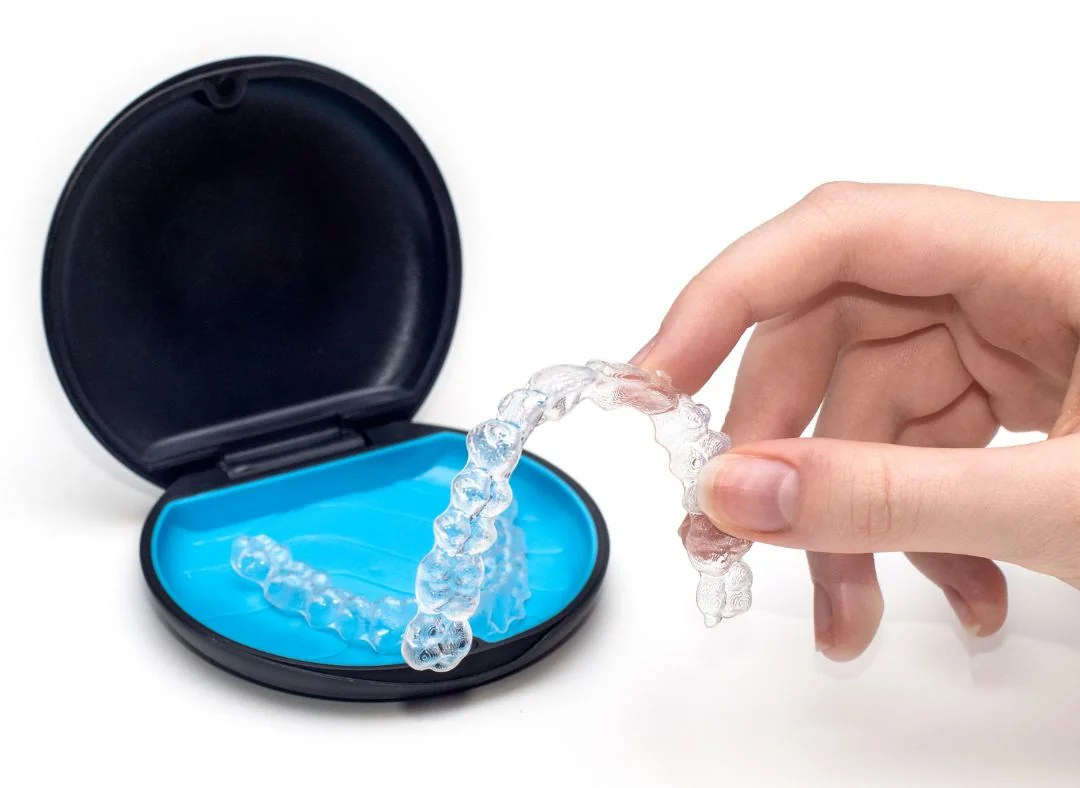
Within these two categories, a wide variety of devices are used as night-time orthodontic appliances; it can be said, almost without exception, that the majority of these are based on splints made from strong yet soft and gentle plastic, which are easy to remove and replace.
In this respect, a strong parallel can be drawn between night-time braces and Invisalign technology, which also holds its own in this regard.
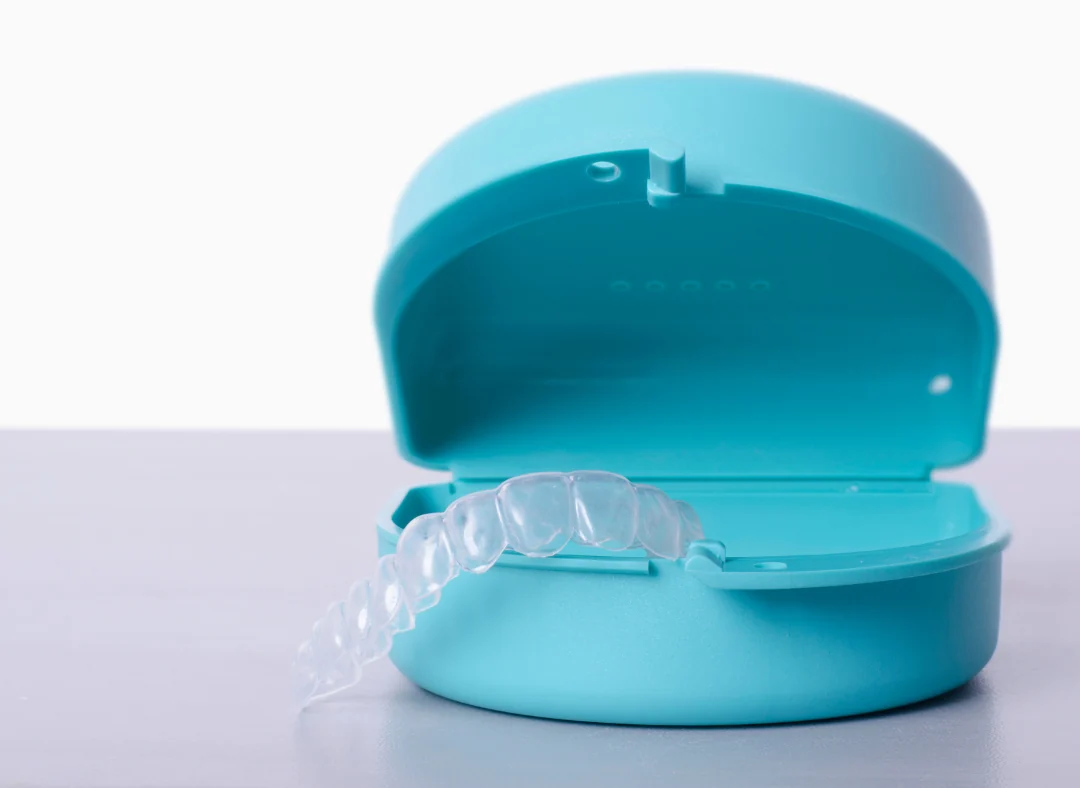
Invisalign as a night-time brace
The Invisalign system cannot be regarded as a night-time aligner in the traditional sense, yet it is still capable of performing this function effectively – even in adulthood, of course.
The reason for this is that the Invisalign braces The key to its effective use is consistent wear. Patients must wear it for at least 20–22 hours a day, including during the night.
It is true that the aligners should not be removed during the day – except, at most, for eating and maintaining oral hygiene – however, thanks to their transparency and comfort, they are the most discreet orthodontic solution, which does not interfere with communication, work or studies.
The key to how Invisalign works is that, during treatment, patients are provided with a series of aligners, which usually need to be changed at two- to four-week intervals, as this allows the pressure on the teeth to be gradually increased.
It is important to note that Invisalign can also be used exclusively for night-time wear, but only as a retainer to maintain the results achieved through previous successful orthodontic treatment.
Night-time orthodontic treatment for children
Night-time orthodontic treatment is primarily intended for children, and particularly teenagers, once their permanent teeth have come through; it can help them achieve a straight smile without any discomfort and even in complete secrecy.
It is very important to note that night-time appliances primarily serve a minor corrective role; as such, they play a key role in addressing existing but mild malocclusions, as well as in regulating the growth and development of the jawbone.
Contrary to popular belief, it very often cannot replace traditional braces; as such, it is usually used either for preventative purposes or to maintain the results of previous treatment.
Whether a night-time brace is sufficient for our child is always determined by a specialist, based on thorough examinations and a personalised diagnosis.
Night-time orthodontic treatment for adults
There are cases where night-time orthodontic treatment can also be used in adults, but in such cases the indications are very limited, so it is really only an option for correcting milder malocclusions.
With permanent teeth, wearing the appliance only at night is not enough; with permanent teeth, constant pressure needs to be applied throughout adulthood in order for visible and lasting changes to occur.
It is therefore advisable to opt for invisible braces in adulthood, as, in addition to being the most effective overnight treatment, they are also sufficiently discreet during the day and do not interfere with everyday activities.
The Invisalign system, for example, must be worn all day, even whilst sleeping, but can be removed when eating, brushing your teeth or for special occasions. The best results are achieved when it is worn for at least 20–22 hours a day.
Apart from its discretion, the greatest advantage of this method is that it can be used to treat not only mild but also moderate crowding or malocclusions.
Frequently asked questions
Can a night-time aligner replace fixed braces?
This always depends on the type and severity of the dental problem. The use of night-time braces is very limited; they are generally only effective in milder cases, whilst for moderate or severe misalignments, the use of fixed braces or braces designed to be worn all day is unavoidable.
How many hours a day should you wear your night-time braces?
You need to wear these devices for at least 10–14 hours in order to achieve the desired results. This means that it is often not enough to wear them only at night; you also need to start using them in the afternoon to achieve your goal.
How long do I need to wear my night-time braces?
The duration of treatment is always determined by the dentist. It depends on the severity of the problem, the type of braces used and the patient’s compliance. For some people, treatment takes just a few months, whilst for others it can take years.
How painful is it to wear a night-time brace?
You may experience some minor discomfort at first, but in most cases you will only feel a slight pressure. However, this always depends on the type of braces you choose.
How should you clean your night-time braces?
This is always determined by the type of braces. However, as a general rule, thorough cleaning with lukewarm water is required after every removal and before every refitting.
Can you eat and drink whilst wearing night-time braces?
Apart from water, it is not recommended to consume any other drinks or food, as this may damage the device and, due to the proliferation of bacteria, increase the risk of tooth decay and gum disease.
Why is night-time orthodontic treatment more effective for children?
Because children’s jawbones are still developing, their permanent teeth can be moved more easily, which significantly increases the effectiveness of treatment.
Can a night-time aligner be used on just one jaw?
Of course, there are devices that can only be used on one jaw. As it is common for dental problems to affect only the lower or only the upper jaw, it is sufficient in such cases to focus the treatment on just one of them.
When can you start wearing night-time braces?
This always depends on the stage of development of the child’s teeth. Treatment can usually begin as soon as the first permanent teeth appear alongside the milk teeth.
Is it possible to treat several problems at once with night-time orthodontic treatment?
To a limited extent, yes, but it is important that this is only done when the cumulative problems are less severe. In overly complex cases or where there are more severe abnormalities, the use of fixed braces is recommended in almost all cases.
What is retention?
Retention is the so-called stabilisation phase that follows orthodontic treatment. Night-time orthodontic treatment is often a form of retention in itself; for example, following Invisalign treatment, patients are often required to wear the final aligner only at night for a few months.