


When someone needs a dental prosthesis, removable dentures are increasingly rarely considered nowadays. People are looking for more reliable, durable, and aesthetically pleasing alternatives, and implants are capable of meeting the associated needs in a modern way.
Using various types of implants, a missing single tooth can be replaced just as durably as problems affecting the entire dentition.
As dental prosthetics are indispensable in modern dentistry today, there is an ever-increasing range of options offered by individual manufacturers, and indeed in terms of price. Implants can, of course, also be classified according to their size, material, and other characteristics.
As the range is truly enormous, we have listed the options below to make it easier to navigate the individual types.
What considerations should be made when choosing between implant types?
The placement of an implant is among the more costly dental procedures, so it is very important to choose carefully in several respects.
Firstly, it is essential that the procedure is carried out exclusively in a place where a qualified implantologist works. Dental restoration is a specialist field within dentistry, which requires a great deal of expertise and practice.
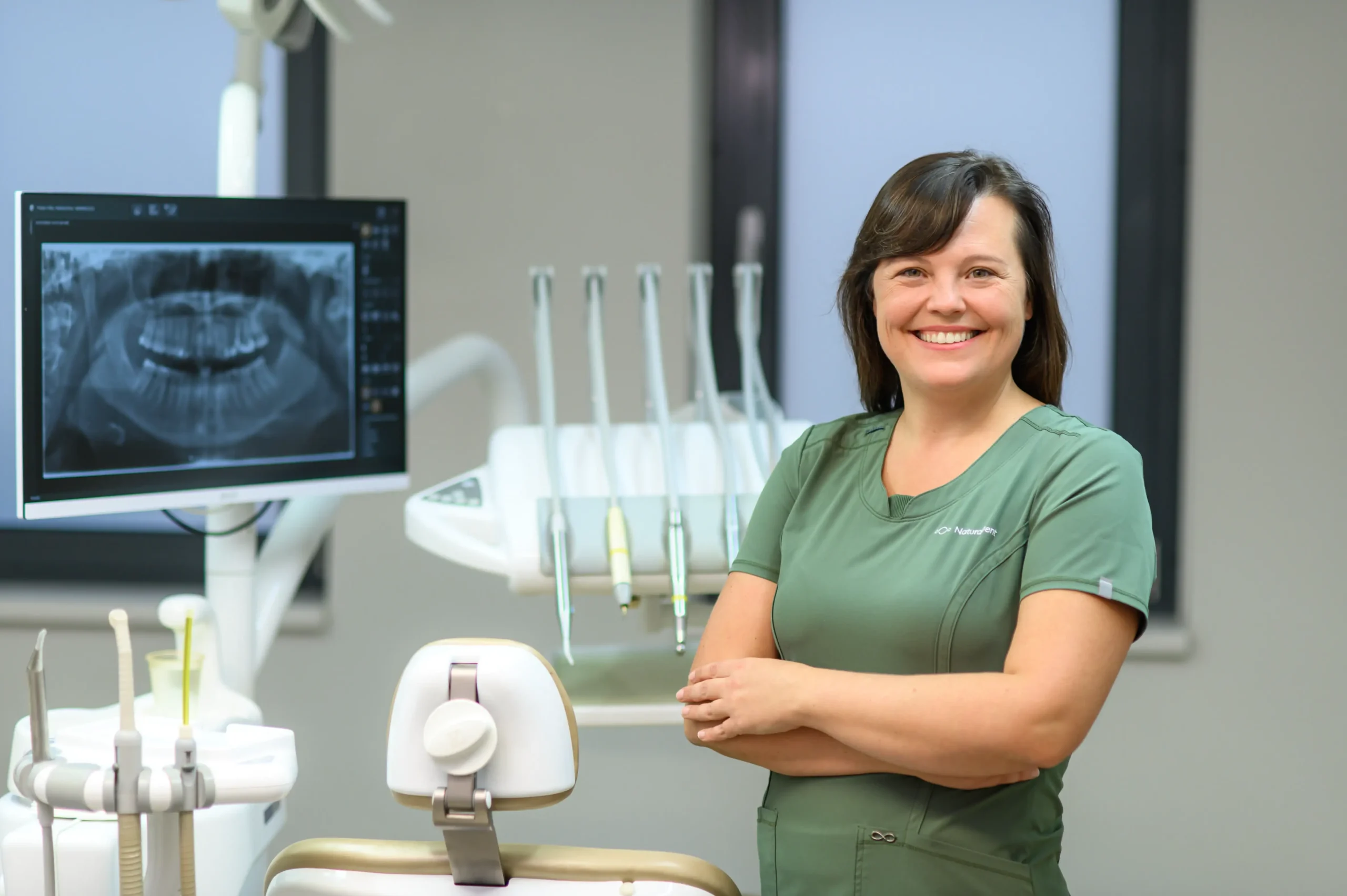
At the NaturaDent clinic, for example Dr. Márta Fülöp Papp chief dentist and Dr Amirhossein Golkhorshidi These procedures are carried out by two MSc-qualified implantologists, both of whom trained in Germany and are currently conducting research in the fields of bone regeneration, bone grafting and implantology.
If someone implant If you are looking to buy one, you will typically base your decision on price first and foremost. Cheaper products of dubious quality have now appeared on the market, but these cannot under any circumstances be regarded as a suitable solution in the long term.
As dental prostheses are ideally lifelong, it is worth choosing the higher quality types, which are usually more expensive, but the investment will always pay off in such cases.
Not only can a better fit be guaranteed with quality implants, but the chances of potential complications can also be reduced.
When considering an implant, we always take the following into account:
- Only choose manufacturers who produce high-quality products. (It's worth seeking advice from an implantologist in this regard!)
- The given implant and the prosthetic restoration placed on it have a sufficient warranty period.
- Finally, but not least importantly, the implant must fit our teeth and jawbone in every respect, and an implantologist can advise on this too.
The manufacturer's question regarding implant types
When fitting dentures, it is very important to address the question of the manufacturer, as, as we have written above: more and more products are appearing on the market, however, not all of them are able to provide the quality that can be expected in this case.
Reliability and high quality are most often reflected in the price tag, which is why we are proud that at NaturaDent we only work with premium implants in our practice, and our patients thus receive the best quality and the most modern technological background.
We exclusively use the solutions from BTI implants, the manufacturer that was the first to win the ”cleanest implant” award in the dental implant market. While few people in Hungary know about them, they are considered among the leading manufacturers abroad, as they focus far more on research and development than on marketing.

The most common implant types
Naturally, the individual implant types can be classified not only in terms of manufacturers or quality, but also in terms of their properties and design.
From this perspective, we can establish further groupings, as we can distinguish between traditional prosthetics, and single- and two-phase implants, but we must also address the types based on size and material.
This knowledge should also be acquired by prospective patients, so we have summarised the most important information about the individual variants in an easily understandable way below.

Traditional implant
The traditional implant is the most frequently used dental prosthesis. In such cases, the screw part is first implanted into the jawbone, which is always followed by a healing process.
It is very important that the implant rests at this time, as it needs to integrate properly into the bone tissue for stable support. The next step, which involves fixing the superstructure, can only begin after complete healing.
The aim is for the final result to match the original dentition in both aesthetics and function. The placement of a traditional implant is a process that can take months, and with the right expertise, it achieves a very high success rate.
“Immediate implantation“
Unlike the traditional approach, with immediate implantation, the screw used to secure the dental prosthesis can be inserted straight after the tooth has been extracted. Whether this is feasible always depends on the patient, as it requires a sufficiently strong jawbone.
In an optimal scenario, the temporary replacement may be fitted onto the freshly inserted implant on the same day, but within one to two days at the latest. In certain cases – particularly with front teeth that are always visible – this can be very important for aesthetic reasons. This temporary replacement should not be subjected to any kind of biting or chewing force; it is in the mouth solely for aesthetic purposes.
However, it should not be forgotten that immediately loadable implants can be used in much rarer cases, and the so-called rejection rate of the prosthesis is significantly higher than with the traditional solution.
It is important to emphasise that the name of the implant in question can be very misleading, as these implants must not be subjected to any strain for 8–12 weeks, and patients should only eat soft foods, as healing requires complete osseointegration, which can take a long time – usually at least 4–5 months before Crown it will be put on it.
Implant type sizes
When it comes to implant types, it's also important to discuss their size differences, as we can distinguish between three main groups in this area.
In terms of sizing, for an implant, we're talking about the diameter of the screw to be inserted, which is typically always determined by the implantologist, but the patient also needs to be aware of it.
Standard implant
Standard-sized implants typically have a diameter of 3.5-4.2 millimetres. They are standard because this is a common or general size when it comes to replacing front teeth.
Wide implant
Wide-design implants are 4.5-6 millimetres in diameter, and are consequently used to replace molars subjected to greater loads.
Mini-implant
The placement of mini-implants is considered when there is very little jawbone mass, or if the teeth are too crowded. These implants typically have a diameter of 2-3.5 millimetres.
Implant types by base material
Modern dental implants are typically made from two types of base material, with most being made from titanium and another portion from zirconium dioxide.
Whichever we choose, it should be known that such dental restorations are now provided with a very powerful surface treatment, which helps to achieve a more natural appearance, as well as making them much more durable.
Furthermore, such surface treatments accelerate healing, bone tissue adhesion, and there are even coatings that, due to their properties, can reduce the likelihood of inflammation developing.
Titanium implant
Most implants are typically made from titanium or its alloys. There are very simple reasons for this, but the most compelling is undoubtedly that this material contains no allergens, so the chance of rejection or allergic reaction is lower following implantation.
In addition, titanium is extremely strong, durable and has enormous load-bearing capacity, meaning it has not only the same, but superior properties to traditional teeth.
Zirconia implant
Zirconium dioxide is less popular among implant types. It is also an extremely hard base material, which can actually be considered a type of strong ceramic, and due to this property, it is an extremely brittle material and prone to fracture.
On the one hand, it contains no allergens, and has high strength, stability, and load-bearing capacity, but it should be known that its removal is much more difficult than that of implants made from the other raw material.