


The topic of teeth whitening can be divided into several smaller groups, both in terms of technological background and applicability.
Laser Teeth whitening The process most often affects the entire set of teeth, however, there are some conditions when only a single tooth needs to undergo such aesthetic treatment.
This is because the shade of some teeth can completely change over time. Besides yellowing, a grey tooth surface is often observed due to external or internal factors, which many people believe can only be corrected with a crown or with a ceramic shell It can be removed.
In reality, however, this is not the case at all, as most discoloured teeth respond very well to modern treatment options such as Laser teeth whitening available at Nautadent.
However, you should be aware that whitening a discoloured tooth is always a multi-stage process; sometimes it is supplemented with root canal treatment or requires several attempts to achieve a sufficiently aesthetic result.
In our article, we'll explore what causes teeth to discolour and how laser teeth whitening addresses such problems, along with some useful practical advice.
What can make a tooth turn grey?
To better understand the effect of laser teeth whitening on a discoloured tooth, it is very important to know the underlying cause of the discolouration.
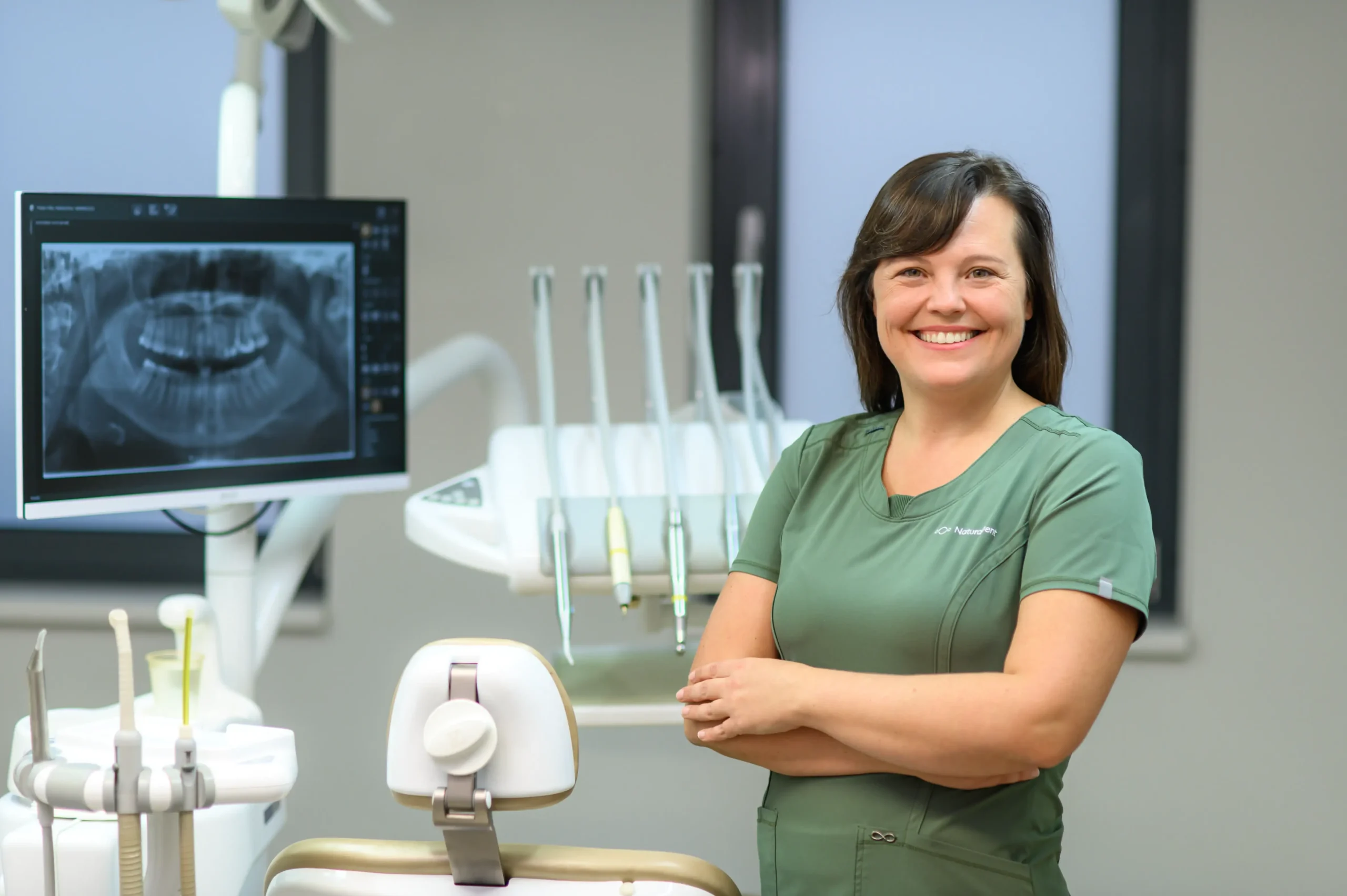
At our laser dentistry practice, we naturally start all similar cases with a comprehensive examination, as even experienced dentists need to understand the factors behind the discolouration.
A panoramic X-ray of the entire set of teeth will be taken, which is usually sufficient to make a diagnosis, but in rare cases, additional imaging diagnostic methods may be required.
The tooth most often turns grey because of root canal treatment.
An X-ray can immediately show whether the affected tooth has undergone root canal treatment before. This is important because in the vast majority of cases, root canal treatment causes grey discolouration of the teeth.
This intervention is particularly popular in dentistry – for example, when permanently eliminating toothache – however, it should be known that teeth that have undergone root canal treatment will practically no longer be alive.
They will retain their function, but will not be able to regenerate as a living tooth root would. It varies from patient to patient when this problem develops after root canal treatment; for some it may occur within a few months, while for others it may only manifest as greying years later, or never at all.
Other reasons for a discoloured tooth
Naturally, it's not just root-treated teeth that are prone to becoming discoloured and greyish on the outside. Deep decay, trauma, or general necrosis, which in many cases has no preceding factors, can often cause such problems.
It is very rare for teeth to be found with discolouration in the background. In such cases, pathological tooth contact can mostly trigger this change, due to improper bite structure.
In the latter case, laser teeth whitening is not the first course of action; it is far more important to eliminate the root cause of the problem. Sometimes, simply smoothing the affected tooth is sufficient, but at other times, only orthodontic treatment can help.
Internal tooth whitening usually helps in cases of discoloured teeth.
The inside Teeth whitening One of its biggest advantages is that it can be used very effectively even on heavily discoloured teeth.
This is why dental whitening processes can be initiated within the tooth as part of the process, which are unattainable with other methods.
The best results can be achieved with hydrogen peroxide, which needs to be replaced in the tooth occasionally on a weekly basis. Once the desired tooth whitening is achieved, the tooth will then receive a calcium treatment. The process is completed by creating a final filling that perfectly matches the tooth's colour.
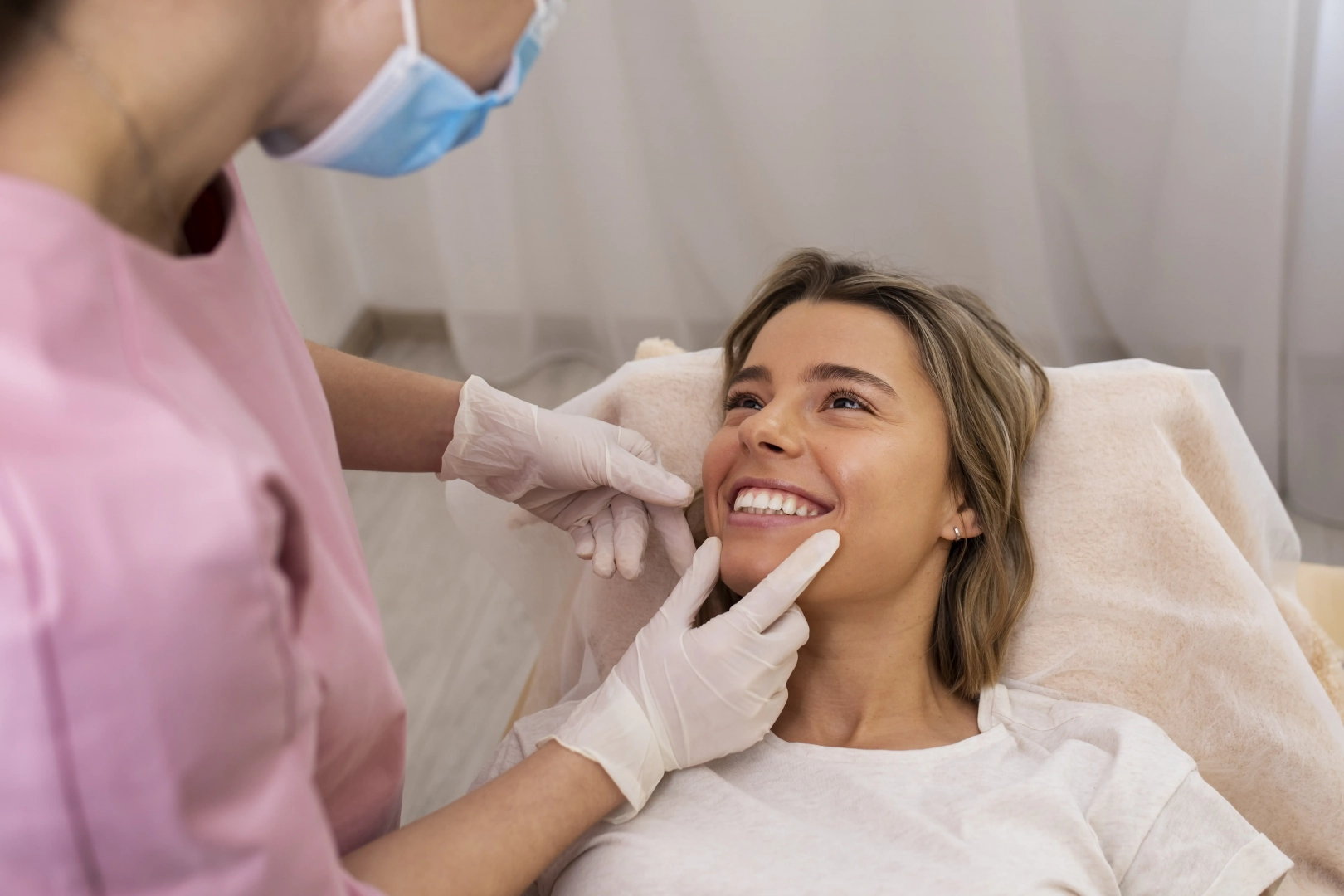
In the first instance, the dentist must ascertain what might be the cause of the discolouration of the tooth in question. This helps in selecting a personalised treatment. It may occur that other factors, potentially related to lifestyle, have contributed to the greyish or yellowish appearance of the teeth.
The BIOLASE laser provides a fast, advanced, and chemical-free whitening solution.
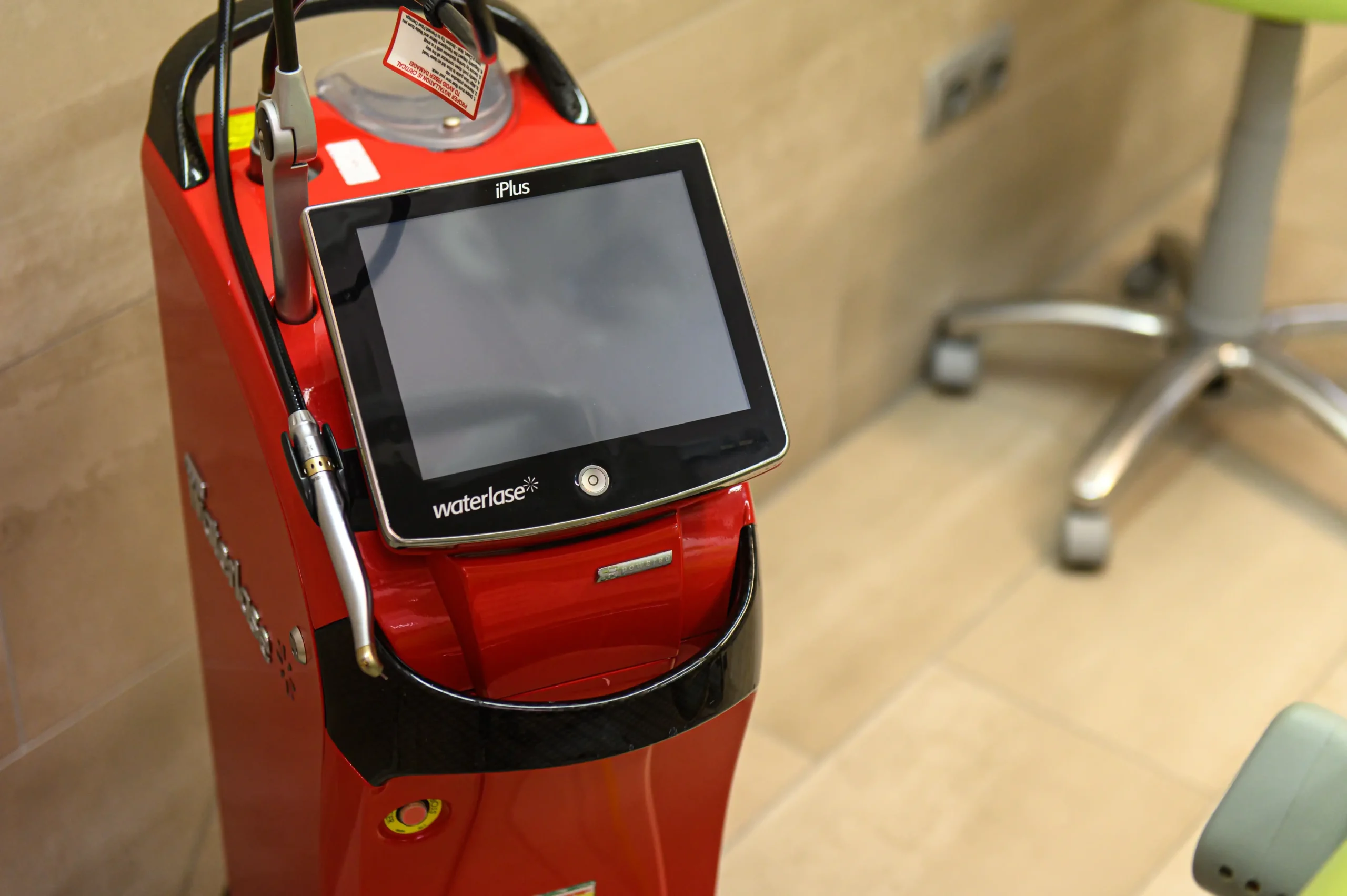
At our dental practice, we perform laser teeth whitening using the ultra-modern Biolase equipment. This is a laser device designed for direct dental procedures, which, alongside the application of the latest technologies, is capable of whitening yellow or discoloured teeth quickly, gently, and without harmful substances.
It is so effective that, depending on the original colour of the teeth, it can make them up to 6-8 shades whiter in the best-case scenario. Another advantage is that when laser is used, not only can discolouration be said goodbye to, but also sensitivity to cold and heat.
Following the application of traditional LED lamp tooth-whitening procedures, a common complaint is that the gums or neck of the tooth become sensitive. The result of laser treatment, however, is that alongside the improvement in shade, we can forget about the previous tooth sensitivity.
Moreover, the benefits of the Biolase laser also include being free of side effects, and it neutralises the debris adhered to the micropores of the teeth, which can more easily prevent tooth decay or tartar build-up.
The process of laser teeth whitening for discoloured teeth
At Naturadent, we place great importance on the most modern technologies and pain-free treatment, as well as ensuring that each procedure is carried out with the highest expertise, yet as quickly as possible.
So let's go through step-by-step how laser teeth whitening takes place!
The first step in the case of discoloured teeth is always a thorough dental cleaning, which is supplemented with sandblasting if necessary, in order to prepare the teeth optimally for whitening, as it is essential to remove tartar from the surface of the teeth before laser tooth whitening. In addition to the deposits, we can polish the surface of the teeth to a shine with the help of pastes and special brushes.
- After tartar removal, the teeth must be rested for 1-14 days before the next step. Laser teeth whitening can only be performed after regeneration, for which the gums are first covered with a special protective material so that the laser light does not cause irritation.
- One of the most important steps in laser teeth whitening is applying the LaserWhite gel required for the procedure to the teeth, which is then illuminated with the Biolase diode laser to accelerate the whitening process.
- The gel is applied arch by arch to the surface, and then it is illuminated with laser light. This is followed by a 10-minute rest for each arch, allowing the teeth to properly absorb the active ingredient from the gel.
- The treatment lasts approximately 60-80 minutes, and at the end, there is nothing more to do than observe and document the final result after washing off the LaserWhite gel.
It should be known that the effect of laser teeth whitening – especially in the case of discoloured or greyed teeth – can vary from patient to patient. The process is influenced by the structure of the teeth, age, and even the thickness of the enamel and the greyness itself.
On average, however, it can be said that laser treatment can make teeth 6-8 shades lighter. The laser teeth whitening material provides the previously listed advantages and gentleness, unlike other teeth whitening procedures, by achieving the desired result through a gentle, continuous active whitening process lasting approximately two weeks.
It is important to highlight that fillings, crowns, bridges, and dentures do not respond to laser teeth whitening. Achieving a uniform shade for the entire set of teeth can be accomplished as a separate treatment.
If discoloured or greyish teeth do not respond adequately to laser teeth whitening
More serious cases of yellowish or discoloured teeth may occur where they do not respond to laser teeth whitening to the extent that would be expected.
Although some degree of improvement is always possible, there may be instances where a significantly whiter shade is needed compared to the other teeth. In such cases, additional treatments may often be necessary. As discussed in more detail at the beginning of the article, one of the most common is internal tooth whitening.
It is important to note that an experienced dentist may suggest at the point of diagnosis that discolouration of a darkened tooth should be corrected with a different aesthetic solution, rather than laser teeth whitening.
During greying, it is common for the root of the problem to stem so deeply that it can only be adequately addressed with some form of covering (e.g. a ceramic veneer, a dental crown).
Ceramic shells are often a good alternative
If the discoloured tooth is located in a position where it only affects the smile zone from one side, then applying a direct veneer can be an excellent alternative.
The solution, made mainly of ceramic, is as aesthetically pleasing as a crown, but in reality, it doesn't require damaging the existing tooth material, or only to a very small extent.
The essence is that a ceramic veneer, which perfectly matches the shade of the teeth, is applied to the external, i.e. visible surface of a discoloured tooth. In most cases, this doesn't require grinding, only preparation of the tooth surface, because the veneer is very thin, yet extremely durable.
It creates a maximally natural end result, and is not only a simple, fast, but also an exceptionally effective way to aesthetically correct a significantly discoloured tooth.
If significant covering is required, a crown can be a good solution
A discoloured tooth may be in a location that is visible from multiple angles when smiling or speaking, making it insufficient to simply cover it with a porcelain veneer from one side.
In such cases, more significant coverage is needed, for which a crown can be a good solution. Although its application requires more significant grinding of the tooth, in return, we get an aesthetic result that fits into the dental arch from all perspectives and angles.
The crown can be made from pressed ceramic or zirconium, or even metal-ceramic. The choice is usually the patient's, however, in case of metal allergy, it is advisable to avoid the latter type. Depending on the patient, these procedures can be combined to achieve the desired harmonious and beautiful smile.