


In most dental practices in Budapest, dental X-rays are regarded as the primary imaging method for all diagnoses and treatment plans.
Modern dentistry would be unimaginable today without it, as it enables dentists to detect abnormalities that are not visible to the naked eye.
Naturally, this diagnostic method also plays a key role at the NaturaDent clinic; we often use it during the initial assessment in order to gain a more comprehensive picture of the condition of the oral cavity and any potential problems.
As this is a very important tool, in this article we have compiled everything you need to know about the role of dental X-rays in Budapest’s dental practices; we will also discuss the different types and even the issue of safety.
What is a dental X-ray?
Dental X-rays are a specialised imaging technique which, using X-rays, produces diagnostic images of the teeth or the jawbone, thereby aiding the detection of abnormalities or the development of a treatment plan.
The principle behind this method is that different types of human tissue absorb radiation to varying degrees; as a result, X-rays are able to effectively reveal the structure of teeth and bones, and even the presence and extent of inflammation.
As X-ray machines have undergone tremendous development in recent years, today’s modern, digital technologies are not only faster and more accurate, but also involve significantly lower radiation exposure than older models.
When and why are dental X-rays needed?
A significant proportion of dental problems are located deep beneath the gums, meaning they remain hidden during conventional examinations. However, X-rays can support both the diagnosis and the treatment plan.
Let’s look at a few common examples where dental X-rays are of particular importance:
- Initial assessment: It provides the dentist with a more detailed picture of the patient’s oral health and of any problems hidden beneath the gums or at the roots of the teeth, thereby improving the accuracy of the assessment.
- Toothache: In the majority of cases, dental X-rays can reveal the underlying causes of toothache, making it much easier to draw up a targeted and effective treatment plan for the procedure.
- Root canal treatment: During root canal treatment, it is essential to gain a thorough understanding of the tooth’s often complex root system beforehand in order to ensure a successful procedure, as any remaining pulp may lead to a recurrence of inflammation and pain.
- Tooth extraction: If there is a possibility that the roots of the tooth are irregular or that complications may arise during tooth extraction, a preliminary X-ray examination can help to minimise these risks.
- Implantation: Dental X-rays may be required at various stages of the implant procedure, but more commonly, a more advanced form of diagnostic imaging is used: 3D CBCT, which is suitable for three-dimensional imaging.
- Orthodontics: Orthodontic treatment generally requires a panoramic or full-mouth X-ray to determine the exact position of the teeth and the specific characteristics of the jaw, as these findings ensure accurate treatment planning.
- Focal point research: As X-rays are excellent at showing inflamed tissue and foci within the oral cavity, they can also play a key role in the search for foci.
- Periodontal disease: Periodontal disease can be easily diagnosed on the basis of external symptoms, but if we want to find out how it has affected the surrounding bone tissue, a dental X-ray will be required.
Types of dental X-rays
Dental X-rays are generally available in several different formats at dental practices in Budapest, as each type can aid diagnosis and treatment in different circumstances.
Panoramic X-ray
The Panoramic X-ray It is one of the most effective imaging methods, as it allows the entire oral cavity, all the teeth and even the jaws to be depicted in a single image, making it one of the most effective options for a general assessment of oral health.
It is also frequently used for locating lesions, implant placement and orthodontic planning, but can also be used for tooth extraction or root canal treatment where necessary.
Periapical X-ray
The periapical X-ray One of the most commonly used types of intraoral imaging techniques, which can be used to examine one or a few adjacent teeth; its greatest advantage is that it shows the teeth in their entirety, from the root tip to the crown.
It is particularly effective in cases where periodontal disease, tooth decay or other dental problems need to be identified or treated, but it is also effective in detecting inflammation around the root tip, abscesses, cysts and other bone abnormalities.
X-ray
The teleroentgenography It is similar to a panoramic X-ray, as it also allows the entire oral cavity to be visualised, but in this case it is primarily used to analyse the position of the teeth and the jawbone, as well as their relationship to one another.
It is an excellent solution when planning orthodontic treatment and prior to surgical procedures, but it can also be used to assess malocclusions and even growth and developmental abnormalities.
3D CBCT
It is not an X-ray type in the traditional sense, yet it is important to single out the 3D CBCT- which produces a three-dimensional image of the teeth and surrounding tissues. This is the most advanced imaging technique, and is essential for certain procedures.
It plays an indispensable role, for example, in planning dental implant procedures, prior to oral surgery, and also in more complex root canal treatments, where determining the precise location of the roots is key to a successful procedure.
How safe are dental X-rays?
In Budapest’s most modern dental practices, dental X-rays are now based on the latest digital technologies, which involve an extremely low radiation dose and are completely safe.
Radiation exposure is usually lower than the level of everyday background radiation, but dentists still pay close attention to ensuring that diagnostic procedures are only carried out when justified.
The radiation dose is expressed in microsieverts (µSv). For a periapical X-ray, for example, this is just 1–5 µSv, whilst for a panoramic X-ray it is around 10–30 µSv.
Just to put this into perspective, we are exposed to at least 5–10 µSv of natural background radiation in a single day, and even on a short flight we are exposed to 20–40 µSv of radiation. Compared with these figures, the radiation exposure from a dental X-ray is therefore negligible.
Dental X-rays at one of Budapest’s most advanced dental practices
Dental X-rays are available at most dental practices in Budapest; however, it is important to consider carefully which practice to choose, taking into account the technology it uses and the expertise of its staff.
NaturaDent offers patients state-of-the-art diagnostic facilities not only in the capital but throughout the country. Here are a few reasons to choose us:
- State-of-the-art, high-tech equipment: At our practice, we use the latest digital X-ray equipment to provide high-resolution, detailed images, which facilitate diagnosis and help identify treatment options.
- A comprehensive range of X-ray diagnostic services, all under one roof: At our well-equipped clinic in Budapest, we are able to provide a full range of X-ray diagnostic services; whether you need a panoramic or periapical X-ray, or perhaps a 3D CBCT scan, we offer all these options.
- Outstanding professional standards: Our dentists carry out X-ray examinations to the highest professional standards and in accordance with the most stringent safety protocols, to ensure that patients are exposed to as little radiation as possible.
- Quick and convenient solutions: One of the greatest advantages of our practice is its efficiency; by offering online booking and diagnostic tests that can be completed in just a few minutes, we help ensure that our patients do not have to disrupt their daily routines.
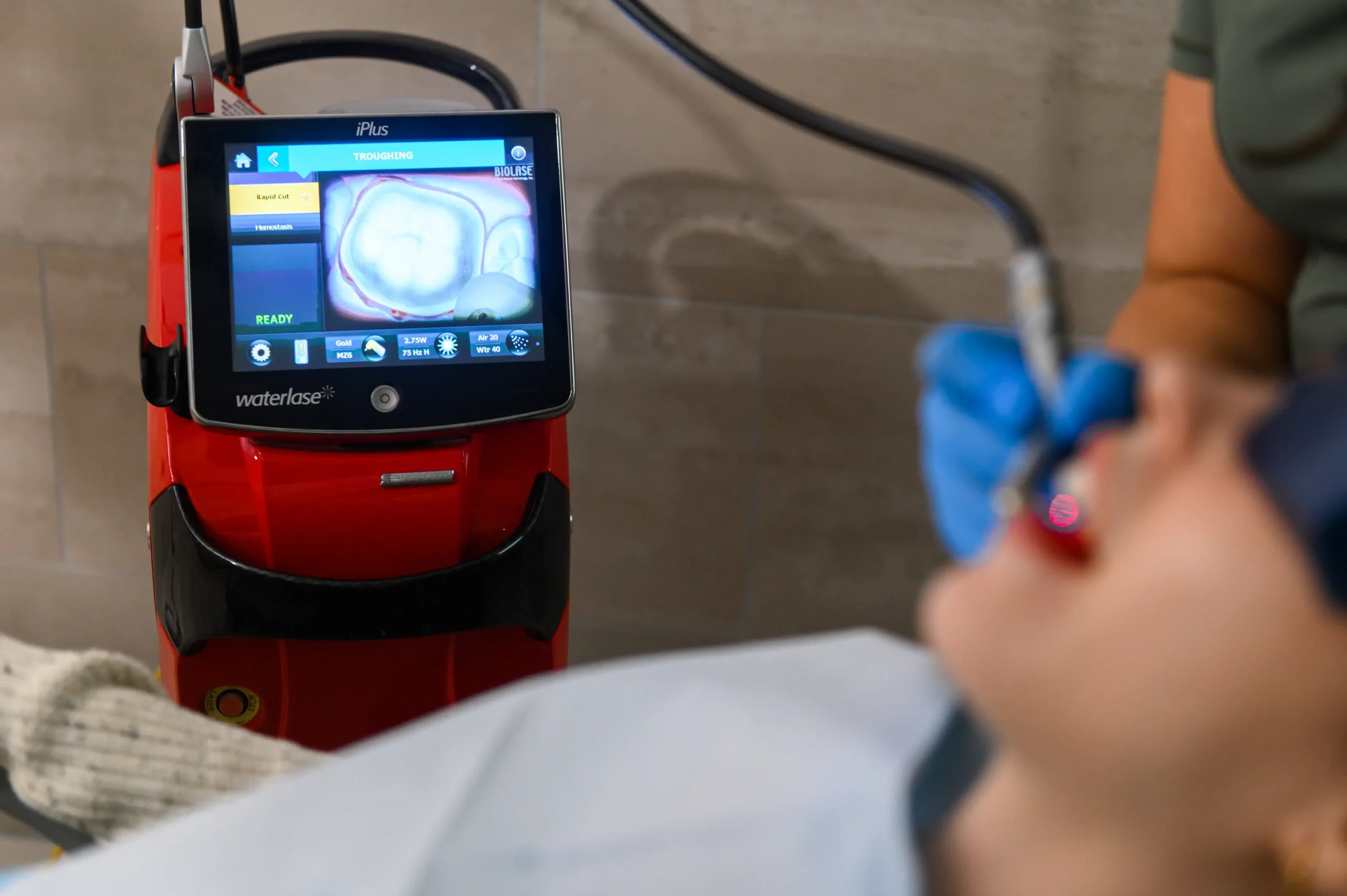
- We handle even complex problems in-house: We provide not only diagnostic services but also patient treatment under one roof. We are pioneers in laser dentistry in Hungary and are able to provide world-class technological support for every treatment.
How much does a dental X-ray cost in Budapest?
The cost of dental X-rays in Budapest can vary from one practice to another. At NaturaDent, it is very important to us that our patients receive outstanding diagnostics and treatment at an affordable price, which is why we have tailored our Western-standard approach to suit the budgets of Budapest residents.
Accordingly, we can carry out a simple periapical X-ray for as little as 9,000 Ft, whilst the cost of imaging for panoramic and full-mouth X-rays is 15,000 Ft, and even the most advanced 3D CBCT scan costs just 25,000 Ft.
Do you need a dental X-ray? Please feel free to contact us!
Fast, professional and safe dental X-rays in the heart of Budapest? NaturaDent offers its patients all this with world-class technology, outstanding professional expertise and, of course, affordable prices.
As well as providing fast and convenient care, we offer all types of tests in-house, with the lowest possible radiation exposure, accurate diagnoses and, where necessary, prompt treatment.
If you have any questions, please do not hesitate to contact us or book an appointment online!
Frequently asked questions
How painful is a dental X-ray?
Not at all; an X-ray examination is completely painless. With intraoral X-rays, you may experience slight discomfort when the sensors are inserted, but this cannot be considered pain either.
How long does a dental X-ray take?
To be precise, the recording takes just a few seconds, but the whole process – including setting things up and following safety protocols – takes no more than 5–10 minutes.
Can dental X-rays be taken during pregnancy?
Radiation exposure of any kind should be avoided during pregnancy, except in justified or urgent cases. Where possible, it is recommended that dental procedures requiring X-rays be scheduled for after the birth.
Can it be used on children?
When justified and using the lowest possible radiation dose, dental X-rays can be used safely on children.
What is the difference between intraoral and extraoral dental X-rays?
Intraoral X-rays are taken inside the oral cavity and generally provide a highly detailed image of a single tooth, whilst extraoral X-rays provide imaging from outside the oral cavity and typically cover a larger area, and can cover the entire set of teeth.
What preparations are needed for a dental X-ray?
The imaging examination does not require any significant preparation; it is simply recommended that metal objects be removed from the area around the affected site, such as earrings, piercings or hair clips.
How often can dental X-rays be taken?
This always depends on the patient and is determined by the dentist. If it is necessary for a course of treatment, it may be repeated as frequently as once a month; in other cases – for example, for the purpose of assessing the patient’s condition – annual check-ups are more common.
Where can I get the best dental X-rays in Budapest?
This is a matter of personal opinion, but the NaturaDent clinic is very popular with patients not only because of its affordable prices, but also because of its meticulous approach and the use of cutting-edge technology.