The best and most modern currently available
Treatments, with world-leading dental technologies

Implant, Periodontology

Our services Dentistry under anaesthesia

Dentistry under anaesthesia

Who, when and why is anaesthesia dentistry good for?

Many patients are afraid of dentists. Yet most are completely relaxed as soon as they enter our cosy downtown office and meet our friendly, knowledgeable staff. For them, our innovative and painless laser dentistry treatments are the perfect solution. Of course, we also think of our patients who have a fear of dental treatments due to childhood fears, panic disorder, nausea caused by increased garatreflex or other reasons.For them, we offer a reliable, predictable and 100% memory-free solution anaesthetic dentistry, which may be used for major oral surgery. These include dental implants, sinus elevation, and removal of cysts or large areas of inflammation.

Anaesthetic dentistry can also be an option for tooth extraction: when 4 wisdom teeth are removed at the same time, anaesthesia (as opposed to local anaesthesia) may be recommended even for people who are not afraid of dental treatments. In fact, our experienced dentists can do much more work during anaesthesia than with traditional anaesthesia.


This is how to attend a sedation treatment!

Although we will carry out a comprehensive assessment at your first appointment and prepare you thoroughly for everything you need to know for a successful anaesthetic treatment, you will find the most important information here too:

  • You should not drink for 3 hours before the procedure and eat 6 hours before the treatment. (This is necessary because the swallowing or coughing reflex does not work during anaesthesia, so there is a risk that the contents of the stomach may be thrown down the throat.)
  • You should tell your anaesthetist beforehand if you are taking any medicines regularly. (You will be advised on how to take them according to the instructions of your anaesthetist.)
  • Because you may need support after the intervention - due to the feeling of drowsiness, Ask a close relative or friend to accompany you to the treatment.! (Important: driving a car is forbidden for 24 hours following the procedure.)

You sleep, we work - The anaesthetic dental treatment process

  • The dental anaesthetist (anaesthesiologist) will review the findings of the preliminary examination.
  • After a physical examination, and after your questions have been answered, anaesthetic dentistry treatment begins.
  • Anaesthesia is administered by a consultant anaesthetist and an anaesthetic assistant. Once you are comfortably positioned, our specialists will monitor your condition throughout the procedure using ECG electrodes placed on your chest and a pulse oximeter clip on your fingertip.
  • After a tiny intravenous puncture, an anaesthetic infusion is hooked up and the anaesthetist places a mask containing pure oxygen in your mouth.
    You fall into a deep sleep. You will not feel any discomfort during the anaesthesia, thanks to the painkillers given intravenously.
  • Our experienced dentist will perform the complete procedure you need. Based on the monitoring, you will spend as much time in our comfortable care until full awakening, until all the parameters of the remission protocol are met.
    You regain your consciousness and the natural beauty and health of your teeth.

Preventative examinations are necessary for dental treatments under anaesthetic! During the consultation, you will receive a full answer to all your questions from our trained specialists, from the reasons for exclusion to what needs to be done and possible side effects.


We welcome you to our comfortable practice in the city centre.

Bone graft

Safe bone graft, made of human tissues, with high technology

In order to provide patients with a safe and stable dental restoration for 50-60 years, in addition to a first-class implant, bone of sufficient thickness is required (in the maxillary sinus).. For guests who have little or poor quality bone stock, for example due to periodontal inflammation, bone augmentation or, in the case of the upper jaw, a sinus lift procedure may be necessary for safe implantation.

In our regenerative bone grafting procedure that promotes new bone formation, we increase bone volume through a so-called augmentation intervention. Although bone replacement materials can be synthetic, of animal origin, or derived from human tissues, a human-derived or mixed solution is recommended for optimal integration. At Naturadent, you will only encounter materials of the highest quality with the best clinical results, whether they are human or xenograft bone replacement materials, locally sourced and prepared granulate from your own bone during surgery, or bone replacement materials created from a mixture of these. Regarding the materials we use, you can be sure that your body will accept them more favourably, as it perceives them as being „closer to itself” than, for example, synthetic bone replacement materials.

Following meticulous bone augmentation at our laser dentistry practice, we implant a dental implant offering outstanding resistance and up to 1.5 times greater stability than traditional titanium implants. At Naturadent, we exclusively use top-quality Swiss and Swedish implants, for which we offer a lifetime guarantee. Following a successful dental implant procedure, we provide three free laser biostimulation sessions to aid the rapid acceptance of the ideal implant for you and to promote the regeneration of the surgical site.


The process of painless bone grafting

Our Head Dentist, Dr. Márta Fülöp Papp Besides laser dentistry, implantation, also a specialist in bone regeneration and bone replacement. Under their direction, we developed our innovative, 6-step treatment process:

  1. We will anaesthetise the area you need so you will not feel any pain during the bone grafting procedure.
  2. Following a professional incision of the gum, the sinus membrane is made visible using a window technique.
  3. The heat-treated, pathogen-free bone graft material, stored in sterile flora, is introduced through the bone window.
  4. To facilitate bone replacement, we close the „window” with an absorbable collagen membrane or a non-absorbable membrane to allow the granular bone substitute to properly attach to the skeleton.
  5. We close the incision with stitches.
  6. You are welcome to visit us 7 days after the treatment for a check-up or suture removal.

Watch the video, how this is realised in practice. 


Not all bone grafts are sinus lifts, but all sinus lifts are bone grafts.

The Sinus lift, a special procedure where the amount of bone is increased by forming new bone from bone grafting material placed under the elevated mucous membrane of the maxillary sinus, utilising the body's regenerative capacity.

At Naturadent, the bone tissue used is screened and sterilised using cutting-edge technology, and the implantation is carried out with the latest equipment and medical care. Thanks to our innovative bone grafting materials and expertise, you can expect not only a safer treatment and a more stable foundation, but also a shorter recovery time and a much lower chance of rejection.

Implantology: „Digital” tooth implantation, dental implant, dental implantation with 3D digital planning and surgical guide

A dental implant is one of the best and most modern methods for addressing tooth loss, both aesthetically and functionally.

Modern implant procedures offer all of this with sufficient safety and durability, so when implanted to the right quality, they not only look like natural teeth, but you can also chew and bite with them in the same way – practically without compromise.

However, quality should be emphasised, as only a few dental practices in Hungary still offer professional implantological procedures.

NaturaDent naturally belongs here, as our team's vast expertise, highly qualified implantologists, outstanding quality implants, and patient-centric approach ensure that tooth replacement truly lasts a lifetime.

Titanium, ceramic, or a combination of both.

As our dental practice places great importance on ensuring each patient receives the implant best suited to them, we strive for the highest quality right from the selection of raw materials.

We exclusively work with premium quality solutions, which is why we use the world's first acquired Clean implant foundation. BTI implants, so the implants we insert are made of pure titanium and are provided with appropriate surface treatment in order to connect perfectly with the bone structure.
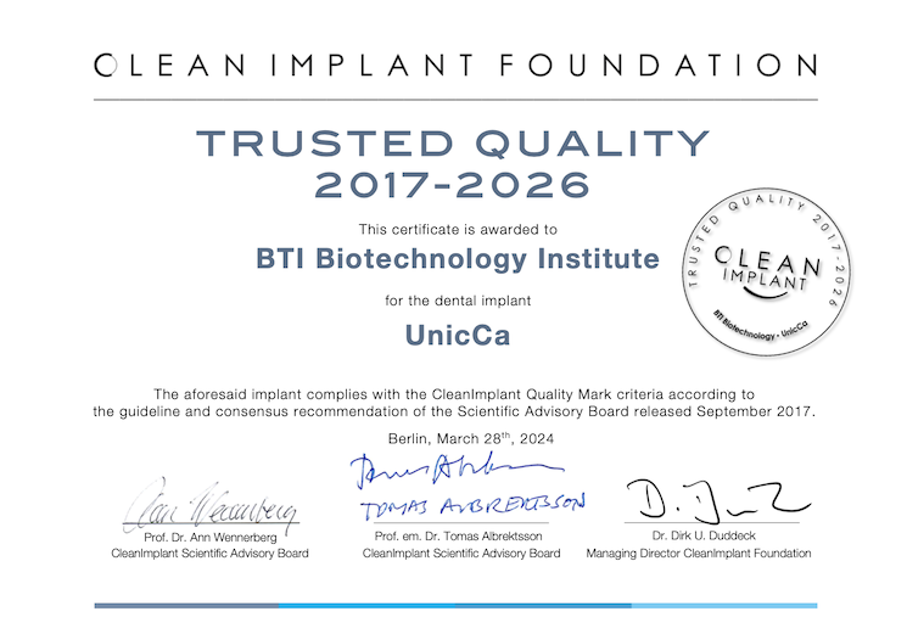
Naturadent BTI certifikáció


This is essential to achieve a strong, practical, and aesthetically flawless result.

Regarding prosthetics and crowns, the range is already wider. In the former case, zirconium and titanium, and in the latter case, metal-ceramic, pressed ceramic, and zirconium-ceramic crowns can be placed on the implanted implant.

In making these choices, we always provide patients with comprehensive information about the benefits and drawbacks, and we make the final decision together.

The procedure for dental implant placement

Health check

As implants fitted by NaturaDent can serve patients for 50-60 years, we pay great attention to adequate preparations. The first step of this will be a state assessment, which is accompanied by a consultation and the taking of diagnostic images.

It is important to explore the intended environment of the implant and the patient's anatomical features, as it may be that the jawbone is thin – this is common in cases of long-term tooth loss – so bone grafting must precede implantation.

Design

If the condition assessment results indicate that the implant can be placed, the next step in the process is planning.

NaturaDent works in this area with three-dimensional spatial computerised x-rays (3D CBCT), which provide a precise background for elaborating even the most fundamental details.

If the jawbone is sufficiently strong and bone grafting is not required, a 3D scan of the patient's teeth is taken, which allows for the precise placement of the dental implant in the bone.

For this, our dental practice uses the most modern Smart Guide technology. With its help, implants can be placed with 100 percent accuracy, and the margin for error can be reduced to a minimum.

Implantation

Precise planning is followed by implant placement. At the NaturaDent clinic, this is considered a routine, painless minor surgery performed under local anaesthetic.

The first step will be to open the gum. This will be followed by the placement of the Smart Template, which helps to create the precise location of the screw in the jawbone, the so-called bone bed, into which the implant, temporarily sealed with a closure screw until the end of the healing period, can be precisely inserted.

The final step of the implantation is to stitch the open gum tissue together for rapid and aesthetic healing.

Placement of superstructure

After the designated healing period has passed, a check-up examination is necessary to verify if the implant has fused correctly with the bone, meaning it can withstand further loading. If so, before the fabrication of the tooth crown, the abutment follows, which ensures the connection between the implant and the future crown.

This is an important element as it can reduce the chances of inflammation around the implant, making not only placement easier but also increasing the durability of the final result. After the abutment is placed, some healing time is again required, along with a small healing cap, which will give the gum around the dental crown a beautifully pleasing shape.

Crown design

If the implant has healed and properly osseointegrated, meaning it can function as a fully integrated artificial root, then the crown can be created, which in the case of multiple implants can be a bridge or even a removable denture.

The type of crown that will be placed on the implant is always decided by the patient, but of course, we also help with this, because the cheapest solution is not always the right one, nor is the most expensive.

To create the crown, a 3D scanner provides the digital impression, allowing for a final result that perfectly matches the other teeth in every respect. The final step of the dental restoration is the proper fixation of the completed crown. In our practice, we use the screw-retained solution instead of cemented crowns, which is a much better option.

Implant aftercare

Despite precise preparation and planning, it's possible that an implant dental restoration may sometimes require post-insertion adjustment. Minor fine-tuning is, of course, possible, as the aim is for the patient to feel that the restoration is a fully functional tooth.

Although our experienced colleagues will inform patients about all aspects of implant aftercare, it should be noted that it is recommended to have the implant checked at least every 6 months, even if there are no complaints.

This is important not only because of the condition of the dental prostheses but also concerning fundamental aspects such as maintaining adequate oral hygiene, as periodontal disease can dislodge an implant just as it can natural teeth.

The patient's most important task during aftercare is therefore to clean the crown attached to the implant and its surroundings just as they would clean a natural tooth.

Why NaturaDent?

In our practice, every patient can receive Western-standard care, which is underpinned not only by our approach but also by our knowledge, the tools we use, and our high-quality implants.

We exclusively work with premium quality implants such as BTI (a strictly controlled, purest implant) or MDI Mini Implant, while from the very beginning of the planning stage, we utilise several solutions that are still only used by a few in this country, such as the Smart Guide digitally designed, pinpoint accurate template technology.

The strength of NaturaDent also lies in the institution's chief implantologist Dr Márta Fülöp Papp MSc MSc MSc., who studied in Germany and currently continues to publish and conduct several research projects on the topic.

The institution's excellences also include Dr Amirhossein Golkhorshidi MSc. As a dentist with a master's degree in implantology, he has enormous experience and practice and awaits patients. At NaturaDent, a whole team of experts is at your disposal. Please feel free to contact us with any questions.


Laser periodontology

World-class procedures for long-term recovery

A periodontológiai kezelésre abban az esetben van szükség, The gums are inflamed, diseased. Although several dental practices deal with inflammatory diseases of the tissues surrounding the teeth caused by bacteria, In Hungary, Naturadent is the only provider using such an innovative procedure in the field of laser periodontology, developed by experts from the world-renowned RWTH Aachen University in Germany.

Our advanced laser treatments can even kill aggressive bacteria in the periodontal bed that even the strongest antibiotics are ineffective against. 

For periodontal treatment, it is crucial to start the treatment process tailored to your condition as soon as possible. This may be a lightning-fast laser pocket cleaning and plaque removal, but in severe cases, our innovative 2-phase treatment series over a 1-year interval may be necessary to save your teeth and ensure uncompromised long-term healing.

At Naturadent's Váci Street practice, we offer open curettage, flap pouch surgery, recession surgery, flap advancement surgery, and the most modern gingival augmentation and thickening procedures using the tunnel technique, among others. This allows you to regain both the health of your teeth and the beauty of your gums.


3 stages, 3 solutions, 3 pieces of good news – Our relevant treatments in more detail

In our 30-minute, painless assessment, we will determine which of the possible periodontal stages you may have, based on the panoramic x-rays taken and a comprehensive examination of your gums and teeth. A detailed treatment plan will be drawn up, which will include, in addition to the necessary treatments, a personalised dental consultation with a precise price quotation.

  • The easiest and fastest to treat condition is gingivitis (stage 1). In this case, our specialist will begin the treatment with a laser disinfection of all teeth. Once the majority of pathogens found in the space between the gum and the tooth (pocket) have been eliminated, a thorough scale and polish will be carried out.Good news is that we also place great emphasis on prevention: after your treatment, our expert will provide dental hygiene advice to help you care for your teeth and gums as effectively as possible.
  • In the early stages of gum disease (stage 2) Even subgingival (below the gum line) tartar can irritate the gums and endanger the integrity of the surrounding bone. Our experienced dentists perform deep cleaning and laser disinfection using the ultra-modern Biolase Waterlase iPlus device to reduce the number of bacteria penetrating the gums to zero.The good news is that the world's most advanced laser dentistry and laser surgery equipment can treat gums, skin and bone without heat, vibration or pressure, using a combination of YSGG laser wavelength and a water-air spray for cooling. In most cases, no anaesthetic or painkillers are needed.
  • For older periodontal disease (stage 3) the bacteria have caused so much bone destruction that your teeth are loose and may fall out without pain or any warning. In our two-phase laser treatment series, we follow the strictest protocols to eliminate large areas of inflammation and restore your teeth and gums to optimal health. This is also thanks to our innovative deep laser cleaning techniques and the germicidal and bactericidal effects of our different wavelength lasers. The first phase consists of a series of 8 treatments, during which we mechanically remove tartar and inflammation from under the gums and disinfect the entire inner and outer surface of the gums surrounding the teeth using a laser. The second phase is a unique procedure, which is necessary to ensure long-term, uncompromised healing, as the bacteria in the gums gradually increase 3-4 months after the first phase of treatment. This must be prevented.The good news is that thanks to Biolase Ezlase/Epic diode laser pocket disinfections, high-power Er,Cr:YSGG laser curettage and our unique professional oral hygiene treatments, we have been able to save the teeth and health of patients who have suffered from cardiovascular problems due to inflammation caused by advanced periodontal disease. 


How does periodontal laser treatment take place?

Periodontology is a continuously developing branch within dentistry, which serves to treat various periodontal diseases and builds upon more complex interventions. Thanks to scientific advancements, laser-assisted periodontology is currently the most modern method for healing all periodontal problems.

The treatment always begins with a thorough assessment of the patient's condition, as their complaints and dentition fundamentally determine the next steps. During the first appointment, alongside a general consultation, pocket charting is essential, for example, as it provides a comprehensive overview of the condition of the teeth and the progression of periodontal disease.

Photographic documentation is also essential, as if periodontal intervention is necessary, there may be more serious conditions, and a complex treatment plan and a series of multi-stage interventions may be required.

Among periodontal laser treatments, you won't only find pocket disinfection. This technology can also be used for procedures such as curettage, laser resection, and even vestibuloplasty. Let's look at these interventions in a bit more detail:

Laser pocket disinfection

Laser disinfection of pockets is required when there is such a build-up of bacteria on the surface of the tooth root that it has already resulted in small cavities, known as pockets.

The lesion can affect a single tooth or the entire dentition. With laser technology, especially its germicidal action, these pockets can be disinfected and thus completely eliminated and cured.

Laser curettage

Laser curettage involves a form of deep laser cleaning, which can be used to destroy the bacteria responsible for tendon inflammation, dead tissue in inflammation and even to heal tissue that is actively inflamed.

It can not only be used to treat existing problems but also has a preventive role, as it can help prevent the development of more severe periodontal diseases.

Laser resection

Laser resection is a periodontal intervention used on premolars where the root tip and root filling can be removed using laser technology. Its significant advantage is that it can minimise pain, bleeding, and other associated discomfort.

Laser vulvoplasty

Laser labiaplasty is necessary if the dental lesion is so severe that it has already had a negative impact on the condition of the gums. Periodontal lasers can be used to restore both health and firmness.

Which dental diseases can be treated with a periodontological laser?

Laser treatment in periodontology has opened up many new avenues in modern dentistry, and many serious lesions can now be treated with this method. Here are the most common ones:

Gingivitis

One of the most common periodontal diseases that is worth treating with laser, in cases where the gums have been sensitive, swollen, reddish in colour, and often bleeding for days, or even weeks. With laser technology, the condition can be healed in as little as a single treatment!

Gumírohadás

If gum recession is left untreated and becomes chronic, gingival recession develops, which can lead to the destruction of gum and bone tissues, and teeth may loosen and fall out. Even more severe conditions can be easily treated with periodontal laser therapy.

Gum recession

Gum recession is typically a symptom of periodontal disease, but it can also occur on its own. When it develops, the crowns of the teeth appear longer, causing a lot of discomfort, sensitivity and pain. However, laser treatment can help to solve this problem.

How does laser treatment help to eliminate periodontal diseases?

Laser technology developed for dental purposes allows laser light to be delivered deep into the pockets that form next to the teeth via a thin fibre, meaning directly to the bacteria and problematic tissues.

The disinfectant action of the laser kills bacteria and diseased tissue, eliminating inflammation. With the help of the laser light, natural regeneration processes are triggered and the gums become firm again, while the undestroyed bone tissue rebuilds itself.

When can periodontal laser treatment be applied?

In all cases where the patient suffers from incipient or severe periodontal disease. It should be noted, however, that for most complex periodontal conditions, it is only a supplementary form of treatment, as in most cases, for example, the tartar removalwill be needed for full recovery.

Further advantages of the treatment are that it can be used in practically all cases, so it does not cause problems even for pregnant women or in cases of diabetes; indeed, in the latter case, this technology is justified and recommended due to its haemostatic effect.

How painful is periodontal laser treatment?

Modern dentistry is built on pain-free treatment in every respect. Periodontological laser treatments are therefore painless; patients may only experience minor discomfort after the anaesthetic begins to wear off.

In addition, periodontal laser treatment involves much less bleeding than traditional methods, the wounds heal completely in a few days, so you can go back to work the next day for almost any job.

How safe is laser periodontal treatment?

Dental laser systems are backed by decades of research and development. In Western countries, lasers have long been used for periodontal treatments, so the latest equipment is completely harmless and has no negative effects on the human body.


We welcome you to our comfortable practice in the city centre.

Quality treatment, empathy, constant attention

Excellent

4.8 | 372 reviews

NaturaDent guarantee

At Naturadent, quality is not a promise, it's a written guarantee: we work with superior materials, cutting-edge technology and highly trained specialists to ensure your smile is in safe hands for the long term. Our dental guarantee means that we not only make it, but we take responsibility for the end result.

Your smile is too valuable to risk - that's why at NaturaDent we not only treat you, but we also offer a written guarantee on all our quality work. We provide solutions that we stand behind today, tomorrow and years from now.

4.7

337 evaluation

Partners and brands we work with

Partners and brands,
who we work with

Search at