


These days, the role of wisdom teeth is becoming increasingly diminished. This is mainly because in today's world, we cut our food into smaller and smaller pieces. Fewer teeth are needed to consume smaller bites, which in turn means that people's jawbones are becoming smaller in size.
In many cases, wisdom teeth do not have enough space to erupt. This can cause several problems for our teeth. Let's see what to do if we are suffering from wisdom tooth pain!
The causes behind wisdom tooth pain
Wisdom teeth are the last teeth to form in the jaw and often do not have enough free space to erupt into the right position. Partially erupted teeth are the most common problem and wisdom tooth pain is also a problem in this case.
Such teeth are partially covered by gum, which results in the formation of a so-called pocket between the tooth and the soft tissue. Food residues can easily get trapped in the bags and cannot be cleaned up with household utensils. The body identifies the accumulated food debris as a foreign substance, and in doing so, tries to defend itself against it. This then leads to inflammation, which causes very strong wisdom tooth pain.
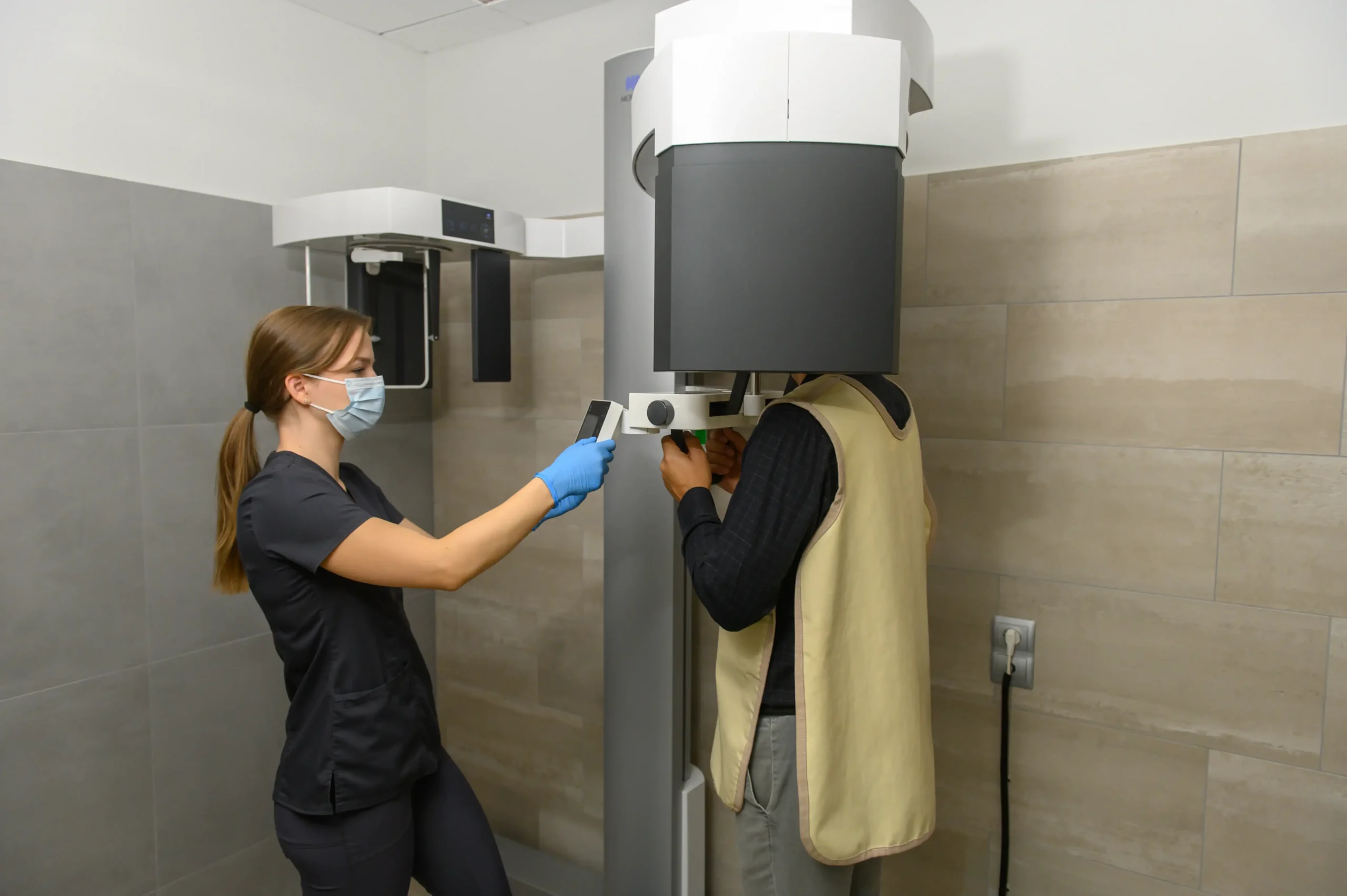
Some wisdom teeth have no symptoms, but you may develop the problem or be at risk of developing a problem you may not have known about. X-rays can clearly reveal the position of the wisdom tooth.
In cases where the tooth has not yet erupted at all, meaning it is completely impacted, wisdom tooth pain can still occur. What could be the cause of this?
The tooth is trying to erupt in the wrong direction, thereby pushing the teeth in front of it, which can cause tension or severe pain. This pressure can cause early-stage decay in the tooth in front of it, and if the wisdom tooth is removed at this stage, the tooth in front can still be saved. However, by delaying the problem, both teeth can reach a state where they cannot be saved.
Please contact our dental colleagues as soon as possible should you experience wisdom tooth pain!
The impacted wisdom tooth is pressing on the tooth in front. Early decay is visible on the tooth in front. It might still be possible to save this decaying tooth.
Horizontally impacted wisdom tooth. Advanced, large decay in the adjacent tooth, both teeth will need to be removed here.
Further complications of wisdom tooth pain
In most cases, inflamed wisdom teeth cause local pain, but in more severe cases, the pain from the upper wisdom teeth can radiate into the ear and into neighbouring teeth.
In lower wisdom teeth, pain may also be felt at the level of the adjacent teeth, but in more severe cases the adjacent muscles may also be affected, resulting in so-called mouth opening restriction or even complete mouth closure.
Wisdom tooth pain - If left untreated
If untreated, inflammation of the teeth can spread, most commonly towards the soft tissues, manifesting as facial swelling. At this point, it's not just wisdom tooth pain that can be detected, but the surrounding tissue as a whole becomes extremely sensitive and painful.
If abscesses appear, see our dentists immediately, as such inflammations can sometimes progress very rapidly and even lead to life-threatening conditions. Remember: wisdom tooth pain requires immediate treatment!
Wisdom tooth pain - How to treat it?
In the case of acute inflammatory processes, the treatment of wisdom tooth pain focuses on the elimination of the inflammation before the removal of the tooth.
Tooth extraction in cases of inflammation is not recommended because it can cause the inflammation to spread and the anaesthetic does not fully affect the inflamed tissues, making the tooth extraction very painful for the patient. At our laser dentistry practice, our primary focus is ensuring our patients receive a pain-free procedure every time.
Find out about wisdom tooth extraction in our related article When is it necessary? How it happens?
Relieving wisdom tooth pain at home
If you experience wisdom tooth pain, there are often underlying issues that require immediate dental intervention.
However, if it occurs on a weekend or public holiday, we cannot immediately book an appointment with a dentist, so it is worth knowing some home remedies that can alleviate this period:
- Painkillers available without prescription:Certain painkillers can be very effective in relieving the pain of a wisdom tooth for up to hours. Ibuprofen and paracetamol are particularly effective, as they usually have an anti-inflammatory effect. Always follow the leaflet when taking them!
- Pain relief gelsPain-relief gels are perfect supplements for providing temporary relief in such cases. Applied directly to the gums, they take away the pain, thus making it easier, for instance, to use less medication.
- Icy topping:Ice compresses on the outside of the face are very effective in relieving wisdom tooth pain and associated swelling.
- Salt water rinsing:Saltwater has a disinfecting effect, thus reducing associated inflammation, and at the same time, pain can also be alleviated.
- Use of medicinal and aromatic plants:Clove and herb oil can also be used for pain and inflammation in the case of toothache, but chilled tea bags, onion, aloe vera, lavender, ginger, turmeric and oregano oils can also be used for this purpose.
Important: these home remedies only temporarily relieve pain and inflammation, providing symptomatic treatment, but do not eliminate the root cause of the problem, so a dental examination and treatment will be essential.
When should we see a dentist immediately for wisdom tooth pain?
The pain of a wisdom tooth should always be taken very seriously and a dental examination should be attended as soon as possible, however, there are some symptoms which, when they appear, mean a visit to the dentist cannot be postponed. These include:
- The pain has persisted for days or returns regularly and gets worse.
- The discomfort is accompanied by minor or major swelling, fever, lymph node changes, difficulty swallowing, and pus discharge from the area around the tooth.
- It is no longer just the tooth that hurts, but also the surrounding areas, the ears, temples, face, neck and head.
- It is especially important to consult a dentist in time if wisdom tooth pain affects children, pregnant women and chronic patients.
How can wisdom tooth pain be prevented?
It's important that you are aware of whether you have wisdom teeth, and if so, their positioning. During regular six-monthly dental check-ups, your dentist will examine their condition, assess their position, and advise whether they need to be removed or if they are fine.
In the case of partially pre-fractured teeth, if the radiographs show that there will be enough space for the tooth to pre-fracture, we usually remove the part of the gum that is blocking the pre-fracture.
If the position of the tooth already indicates on the basis of the X-ray that pre-fracture will not be possible, surgical removal of the tooth is necessary oral surgery instruments. This is either dental treatment under sedation we will carry it out if the patient decides so. This can easily prevent the development of wisdom tooth pain.
Why is the healing time shorter for wisdom teeth extractions at NaturaDent?
During laser dentistry procedures at NaturaDent for wisdom teeth removal we carry out laser disinfection, the inflamed area is thoroughly cleaned. Thanks to these laser dentistry processes, infection is eliminated, the surgical stress on the body is reduced, so that recovery time is halved.
As a complementary therapy, we perform soft laser treatment, which, in addition to its anti-inflammatory and analgesic effects, accelerates tissue regeneration, thus promoting even faster healing time. Thanks to this you do not have to take any leave, you can return to your work as soon as possible.
If you are suffering from wisdom tooth pain, please consult our colleagues who are experts in laser dentistry as soon as possible to alleviate your pain!
Frequently asked questions
What is a wisdom tooth?
The wisdom tooth is the third molar that usually erupts in most people between the ages of 17 and 25, however, for many it never grows in.
How many wisdom teeth do we have?
Normally there are four, two in the lower jaw and two in the upper jaw, but many people may not have any.
Why doesn't everyone have wisdom teeth?
This is mainly due to genetic and evolutionary reasons. People's jaws have become smaller over the millennia, so in many cases there is no room for wisdom teeth.
Why can a wisdom tooth hurt?
In some cases, even the growth of a healthy wisdom tooth can be painful if there is not enough room. However, pain in wisdom teeth that have grown in is typically caused by inflammation due to complications of tooth decay.
Need to pull wisdom teeth?
Not if they are healthy, do not cause oral hygiene problems and do not hurt. However, if they hurt, are inflamed, put pressure on other teeth or cannot come out properly, they should be removed.
Is it worth having wisdom teeth removed as a preventative measure?
If the dental check-up shows that the wisdom tooth may cause problems in the future - for example, it is crooked or cannot be cleaned properly - you should consider extracting a healthy wisdom tooth as a precaution.
How long does it take to have a wisdom tooth extracted?
It always depends on the patient, as wisdom teeth are very often special cases. For this reason, they can take from 20 minutes to 60 minutes to remove.
How painful is wisdom tooth extraction?
As it is performed under local anaesthetic, wisdom tooth extraction is not painful.
Do I always need an X-ray for a pull?
It is recommended because it gives an accurate picture of the condition and location of the tooth, which makes the procedure easier.
When can a wisdom tooth not be extracted?
In case of an acute infection or fever, complications must first be resolved – typically with a course of antibiotics – and only after this can the tooth be removed.
What can we expect after wisdom tooth extraction?
Mild pain, bleeding and swelling are completely normal. It is also important to pay attention to aftercare.
How long does recovery from a tooth extraction take?
In most patients, the scar from a wisdom tooth extraction usually heals in 1-2 weeks, but full recovery can take up to 3-4 weeks.
Can you eat after having a wisdom tooth removed?
For an hour or two after the procedure, it is not recommended to drink anything but clean water, and only from a glass, avoiding straws. After that, you can eat pulpy, liquid or lukewarm foods, but avoid hard, chewy foods for a few days.
Can I work or play sports after wisdom tooth extraction?
If you are not doing physical work, you can return to work the day after the tooth extraction. However, heavy physical work or sport should be avoided for 3-5 days.
How can you tell if the pain is really caused by a wisdom tooth?
Wisdom tooth pain is usually caused by inflammation, which has visible symptoms in the oral cavity. If this is not the case, X-rays can always be used to detect the problem.
What kind of pain is typical of a wisdom tooth?
Variable. Some experience only a dull, continuous throbbing or tenderness, while others suffer unbearable, sharp pain. A common feature is that the pain radiates to surrounding body parts.
Is jaw pain from a wisdom tooth normal?
In the case of an inflamed wisdom tooth in particular, it is quite common for patients to experience pain in the jaw and even in the ear, temple or throat.
Can wisdom teeth cause fever?
Persistent inflammation or infection can lead to fever and, in more severe cases, even high fever.
Can wisdom teeth also cause lockjaw?
Severe inflammation can cause lockjaw. However, it is important to prevent this and seek dental help as soon as possible in case of persistent pain.
How do we know if a wisdom tooth is infected?
If the pain is accompanied by pus discharge from around the tooth, increased swelling and fever accompanied by bad breath, this is usually an indication of an infection of the wisdom tooth.
Can wisdom teeth cause overcrowding?
Yes, and that's precisely why it's worth removing it before it causes aesthetic problems, as that can only be corrected with braces.