


Dental implants have become the most reliable and widely used solution for replacing missing teeth. Research shows that the long-term success rate of dental implants now stands at over 90–95 per cent.
Nevertheless, many patients are quite rightly left wondering: what happens if the implant does end up being rejected? Those who choose the BTI implant system, developed by the Spanish Biotechnology Institute, need not ask this question.
According to the statistics, the risk of rejection for BTI implants is less than 1.5%, whilst for other implants this rate averages between 3 and 4%.
The BTI dental implant is therefore much more likely to perform its function reliably in the long term, even after implantation. But what exactly makes an implant so reliable? Find out in our article!
What are the benefits of a BTI dental implant?
Best surface implant
Its surface is coated with Ca ions. As a result, when the implant is placed in the bone, The blood around it starts to clot within a few minutes.
This is advantageous as it leads to faster osseointegration, meaning the integration into the bone easier, quicker incorporation, the organisation experiences greater acceptance with less burden.
The chance of peri-implantitis is slim.
Anyone who starts researching dental implants will come across the above expression.
Peri-implantitis is an inflammatory condition that affects the gums around a dental implant.
Inflammation can develop in the soft tissues, and even in the bone, around an implanted artificial root due to numerous factors – such as implantation issues, bacterial infection, overload, etc. Effective and timely treatment of this is an essential prerequisite for retaining the implant.
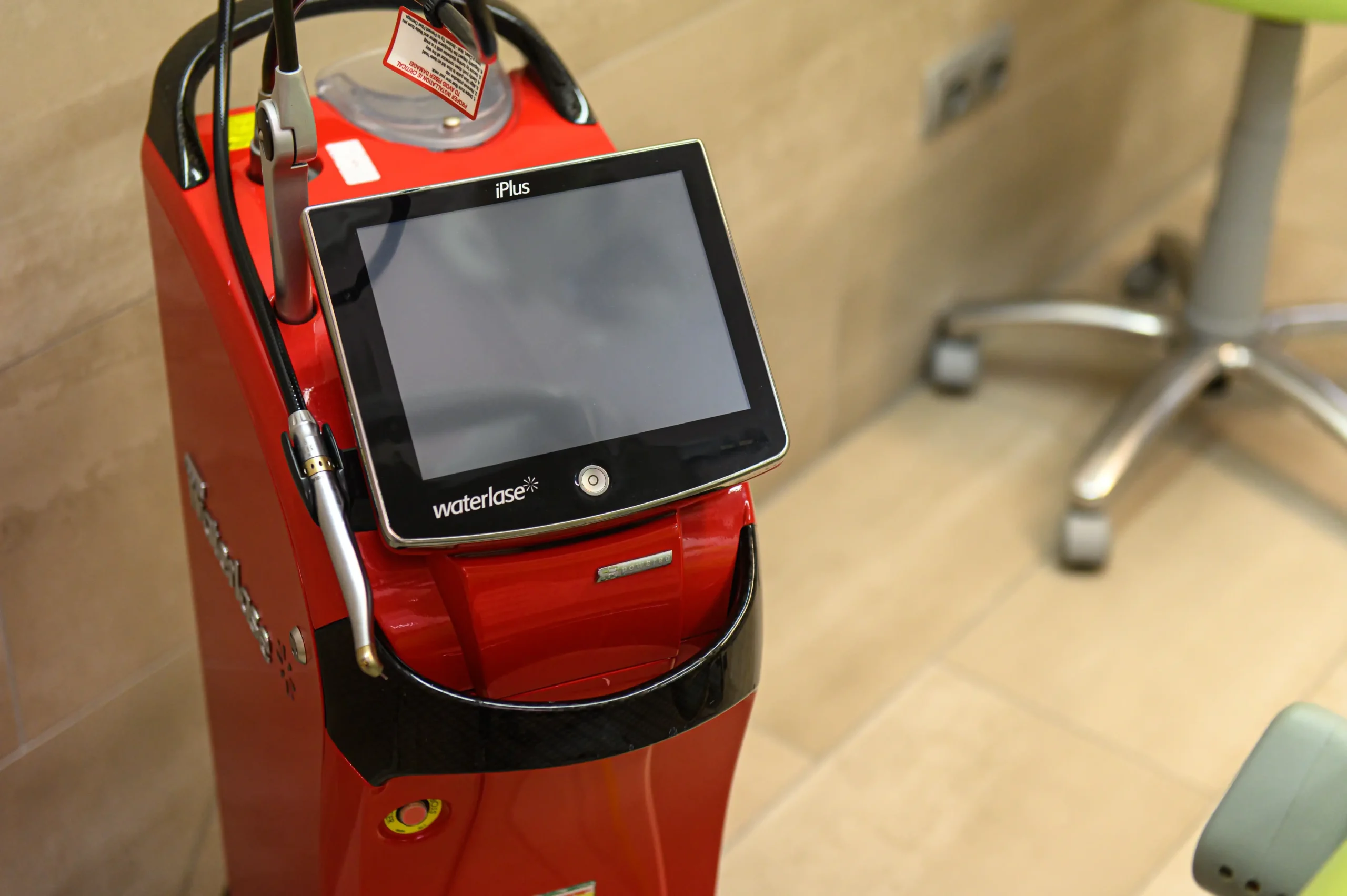
Patients often come to our clinic wanting to save implants they've had placed elsewhere from inflammation around them. We try to help them effectively using a laser. For implants placed by us, our aim is to prevent peri-implantitis from developing.
Different sized BTI dental implants for different cases
If the shape of the dental implant is well-designed, its size may vary.
A maximum 1-2 mm size difference is a significant help from a medical perspective, as bone quality and thickness are not the same for all patients.
In certain cases, it is also possible to opt for a narrower or shorter implant screw than traditional ones, which can even help avoid preliminary surgeries – bone grafting, sinus lift – that would otherwise be necessary.
No bone loss
The insertion of a BTI fog implant is a special procedure. When the oral surgeon places it into the bone, the bone obtained in this way remains reusable: it aids implant integration and stability, so there is no bone loss at all.
Stable crown fixation
A well-functioning prosthesis also requires that the implant screw and the crown form a stable unit. The crown should not wobble or rotate in the mouth, and it should be so comfortable that we don't even notice that the artificial tooth in place of the extracted one isn't our own.
A BTI implant includes prosthetic components that allow for a more stable attachment of the crown, as well as additional accessory elements for surgical and prosthetic procedures.
Read more about bone grafting and dental implants:
- Bone grafting, sinus lift supplemented with own membrane
- Bone replacement with human bone graft material
- Dental implants, dental implant prices, what you need to know
What does ‘rejection’ mean in the context of dental implants?
We can speak of dental implant failure when, for whatever reason, the implantation has not been successful. In this regard, a distinction can be made between early and late failure.
We can speak of early failure when the so-called osseointegration does not occur between the implant and the jawbone; in other words, the bone does not fuse with the implant.
This is essential for stable fixation and fundamentally determines the options available; after all, until the implant has osseointegrated, the crown cannot be built upon it.
We refer to this as ‘late failure’ when healing and osseointegration have taken place correctly, but the implant becomes dislodged from its site due to poor oral hygiene, dental diseases associated with bone loss, or excessive loading.
BTI implants can significantly reduce the risk of rejection resulting from early failure; however, late failure is always determined by patient-specific risk factors, such as poor oral hygiene or smoking.
Frequently asked questions
What makes the surface of the BTI implant special?
This is largely due to the Ca-ion (calcium ion) coating, which has been clinically proven to ensure much faster and stronger osseointegration, i.e. the process of bone formation. This surface is one of the reasons why the risk of rejection is barely 1.5 per cent.
Who is suitable for a BTI implant?
BTI implants are specifically designed for adult patients, but good oral hygiene and a sufficiently strong jawbone are also important factors. They are a good choice for those who want a quick recovery and long-term stability.
How does the BTI differ from other dental implants?
In the fact that BTI implants successfully combine scientifically proven surface treatment with precision design and a rimmed cervical seal, which not only reduces the likelihood of rejection but also enables faster healing. In 2017, BTI’s UnicCa® implant system was the first in the world to receive the CleanImplant Foundation’s „Trusted Quality Seal” certification. The certification assesses the cleanliness/purity of the implant surface based on independent laboratory analyses.
How quickly does a BTI implant integrate?
Observations suggest that, due to the special surface, osseointegration is faster and more effective than with other implants, meaning that, in most cases, a strong bone-implant bond develops within 2–3 months.
For what types of dental restoration can the BTI implant be used?
BTI offers a high degree of flexibility, meaning it can be used for crowns – that is, when replacing a single tooth – whilst also providing an excellent foundation for both implant-supported bridges and the attachment of full dentures.
Can a BTI implant cause an allergic reaction?
It is very rare, as it is made from biocompatible titanium of exceptional purity. Nevertheless, it is advisable for the patient to undergo an allergy test before implantation if they have previously experienced symptoms suggestive of a metal allergy.
How long does a BTI implant last?
Provided the patient maintains good oral hygiene and attends regular dental check-ups, a BTI implant can offer a lifelong solution for missing teeth.
What factors can affect the lifespan of a BTI implant?
In most cases, the lifespan of a BTI implant following successful osseointegration depends solely on the patient’s attitude and lifestyle. Factors such as poor oral hygiene, smoking, untreated diabetes or neglected periodontal disease can all have an impact.
Can more than one BTI implant be fitted at the same time?
Of course, and indeed particularly in cases of complete tooth loss, this is the best way to achieve a sufficiently effective and rapid end result.
Which is the best dental implant?
Which is the best dental implant is always determined by the patient’s needs and circumstances. It is, however, a fact that the BTI implant generally offers the best option, as its beneficial properties reduce risks and extend the lifespan of the dental restoration.